

Pregnancy can be possible again before your first postpartum period. The right time to start birth control depends on the method, breastfeeding, and your health history. Some options may be available soon after delivery; others are started later.
MWC includes family planning and contraception counseling in its postpartum care, so a prenatal or postpartum visit is a good time to review your options with your care team.
When to Plan Postpartum Birth Control
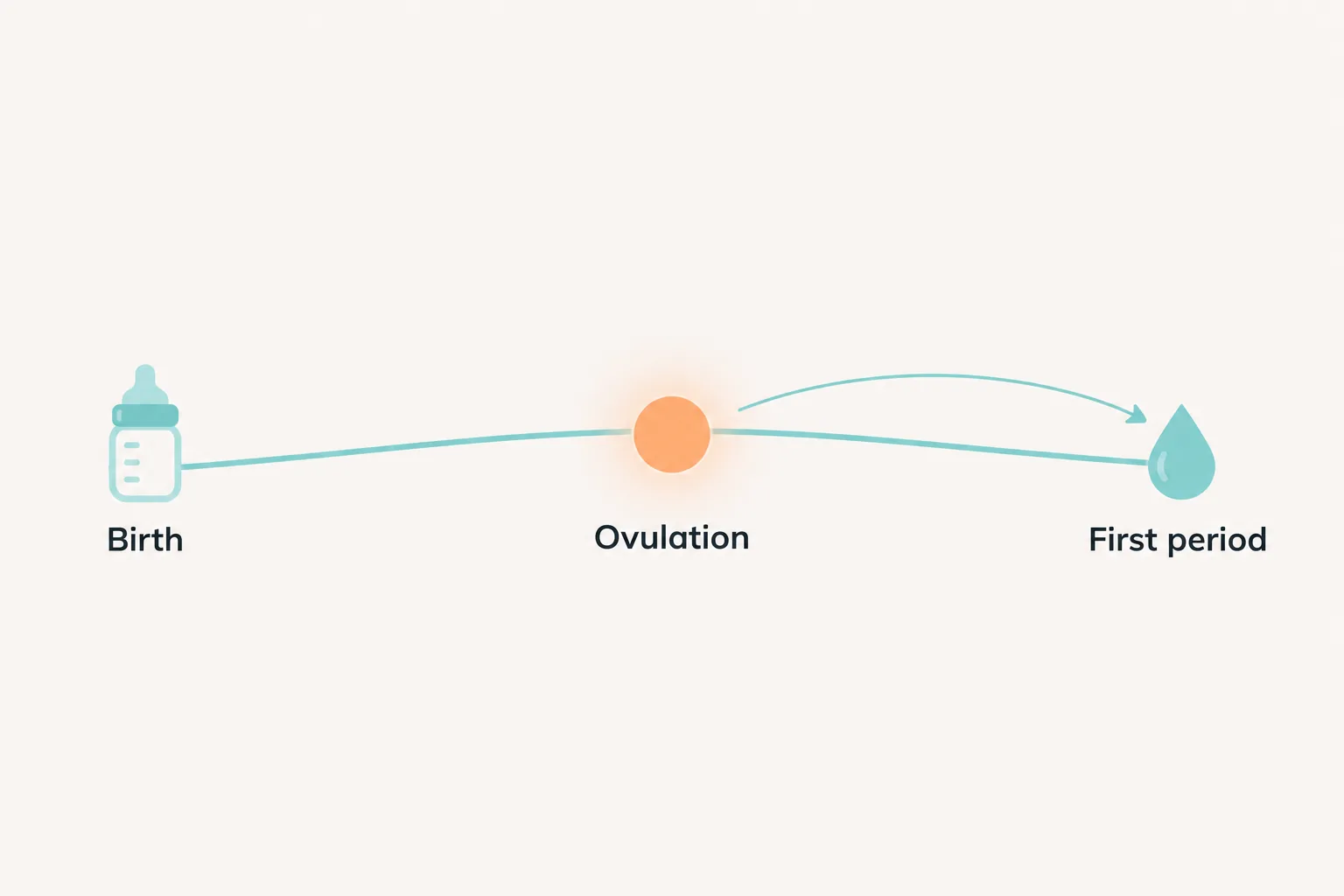
Ovulation can return before your first postpartum period, so a period is not a reliable sign that pregnancy is impossible. The timing varies from person to person. Breastfeeding can lower pregnancy risk, but you should only rely on it for contraception if all the lactational amenorrhea method (LAM) criteria described below are met.
Pregnancy spacing is also part of the conversation. ACOG advises avoiding an interval shorter than six months from delivery to the next conception and counseling about the risks and benefits of conceiving sooner than 18 months. These are discussion points, not a one-size-fits-all rule; your health history and pregnancy goals matter.
You can raise contraception during prenatal care or after delivery; you do not have to choose a method before birth. If you receive care at MWC, you can discuss your questions during a prenatal care visit. Whether a method can be placed before hospital discharge depends on the method, your health, and the delivery setting.
How Soon Can You Start Birth Control After Having a Baby?
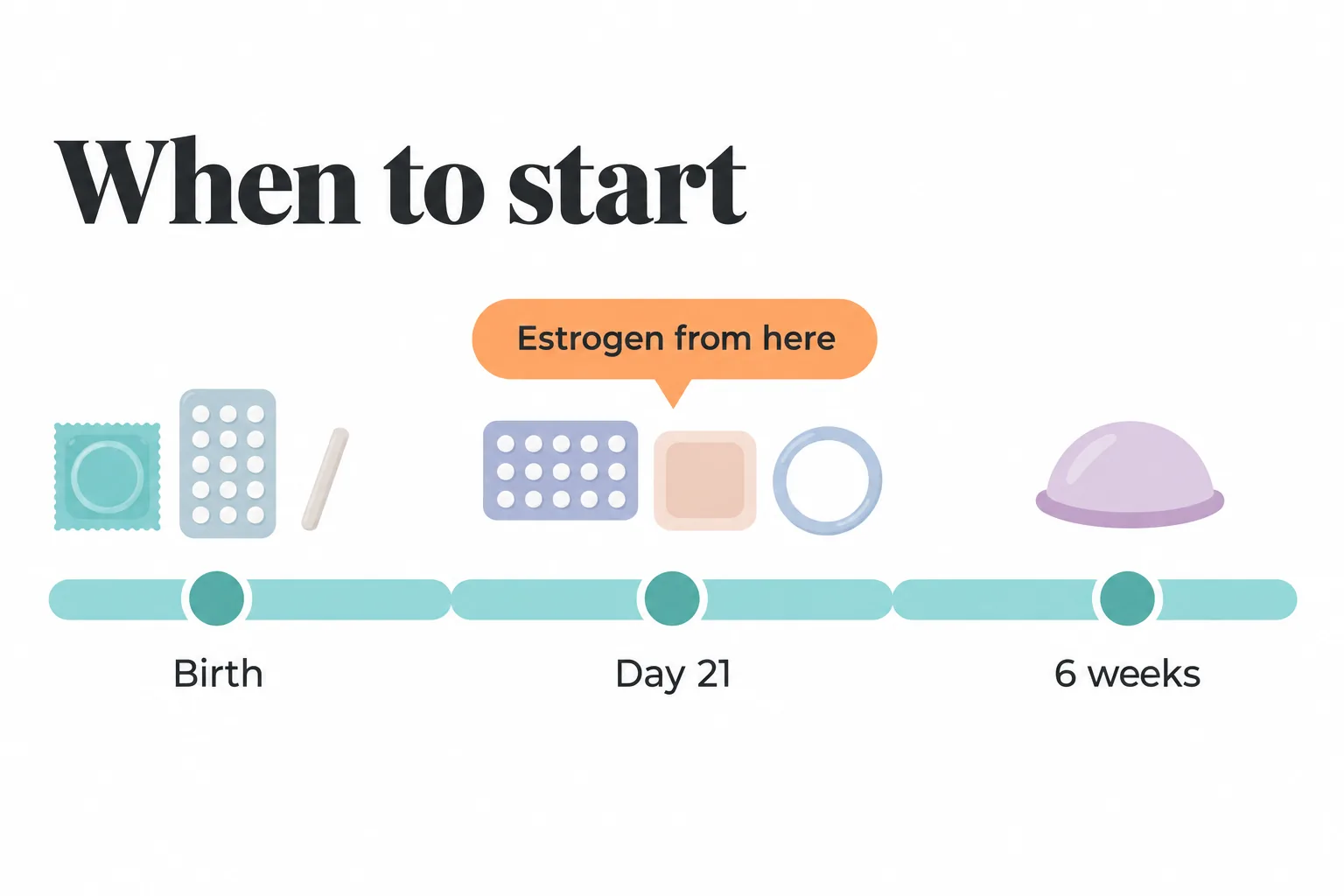
There is no single start date that fits every method or every patient. The table below is a general guide; your clinician can check the timing against your breastfeeding status, health history, and preferences.
| Method | General postpartum timing and points to discuss |
|---|---|
| Condoms | There is no contraception-specific waiting period, but use them when you are ready to resume sex. Condoms also reduce the risk of many sexually transmitted infections (STIs). |
| Progestin-only pill or arm implant | These may be options soon after birth, including before discharge in some settings. The specific pill, your health history, and any need for backup contraception affect the instructions. |
| DMPA contraceptive injection | Postpartum timing depends on your circumstances; CDC guidance and current product labeling differ for exclusively breastfeeding patients. Review timing with your clinician. |
| Hormonal or copper IUD | An IUD may be placed immediately after delivery or at a later visit when clinically appropriate. It is not placed in the setting of postpartum sepsis. Immediate placement has a higher chance of expulsion than placement later. |
| Combined pill, patch, or vaginal ring | These contain estrogen and should not be used in the first 21 days. From day 21 through day 42, eligibility differs by breastfeeding status and clot risk. Breastfeeding patients generally should avoid them until at least day 30; ask a clinician about your individual eligibility. |
| Diaphragm or cervical cap | Do not use before six weeks postpartum; ask whether an existing device needs refitting after birth. |
For method-specific eligibility by postpartum timing, breastfeeding, and medical history, see the CDC’s 2024 U.S. Medical Eligibility Criteria for Contraceptive Use. Availability of immediate postpartum placement also varies by hospital and clinician.
When you start a method, ask when it becomes effective and whether you need a backup method. Instructions vary by method and product, so use the guidance given for the specific option you choose.
If Your Preferred Method Is Not Available Before Discharge
Ask your care team when and where you can start it, whether a temporary method fits your preferences, and how long any backup contraception is needed. You can also ask what to do if you have sex without contraception before the follow-up appointment.
Long-Acting Reversible Contraception: IUDs and the Implant
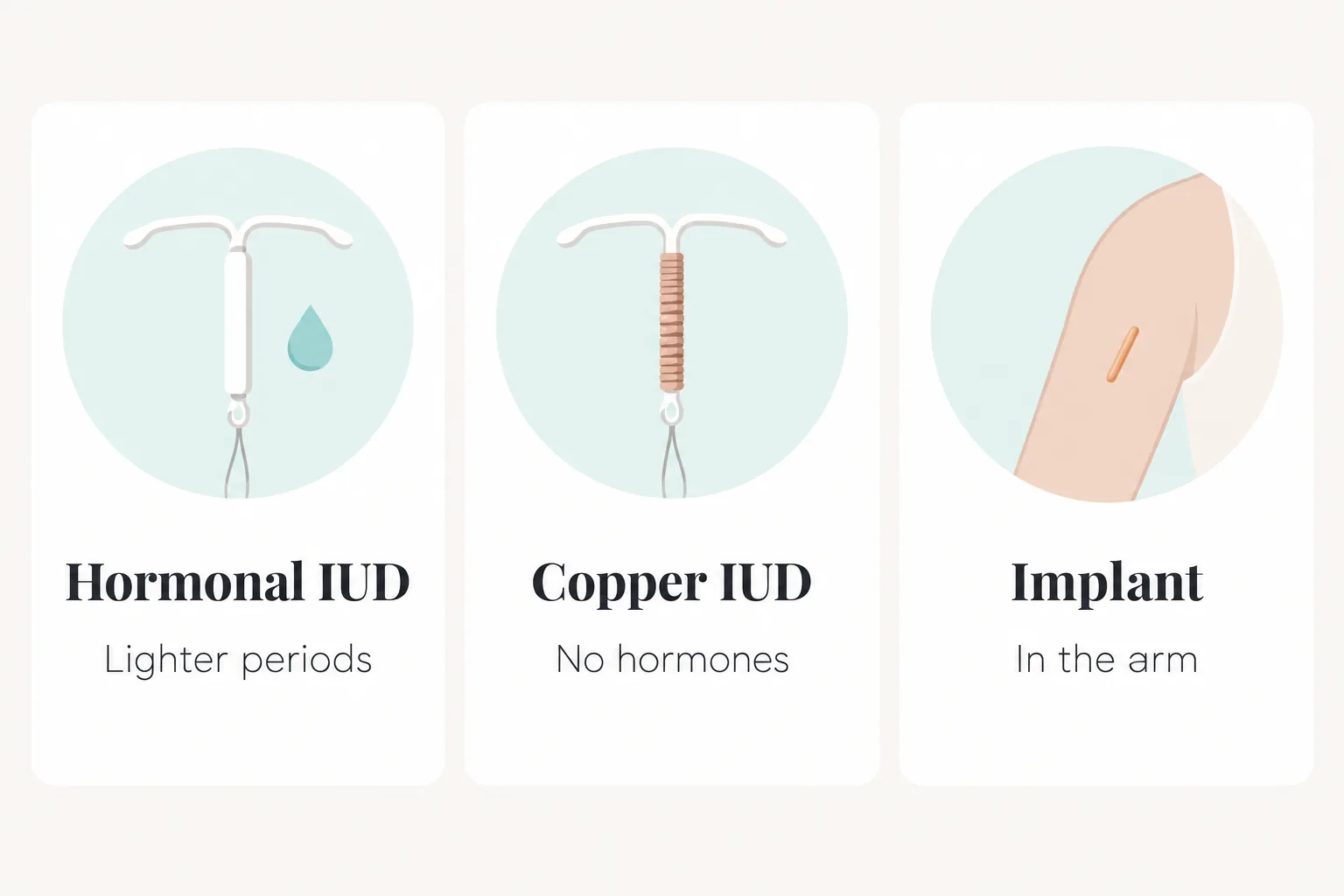
Long-acting reversible contraception (LARC) includes hormonal and copper IUDs and the arm implant. These methods do not require a daily dose, but they differ in hormones, bleeding patterns, placement, and removal.
A hormonal IUD may make periods lighter; a copper IUD contains no hormones and may cause heavier bleeding or cramping for some people. The implant is placed under the skin of the upper arm, and irregular bleeding can occur. Product duration and individual experience vary, so ask your clinician about the specific device.
An IUD placed immediately after delivery has a higher chance of expulsion than one placed later. Ask whether immediate placement is available at your delivery hospital, and discuss the follow-up plan and what to do if you think the IUD has moved.
IUDs and implants are reversible: a clinician can remove them if you want to try for pregnancy or choose another method. Ask how soon fertility may return after removal and how to avoid a gap in contraception if you switch methods.
Combined Hormonal Methods: Pill, Patch, and Ring
Combined pills, patches, and rings contain estrogen and a progestin. Because blood-clot risk is highest in the first weeks after delivery, the CDC’s postpartum guidance for combined hormonal contraception rules them out before day 21.
If you are not breastfeeding, use from day 21 through day 42 may be an option when you have no additional clot risk factors. If you are breastfeeding, use is generally discouraged from day 21 through day 29; from day 30 through day 42, clot risk affects eligibility. After day 42, breastfeeding patients generally can use these methods, subject to other medical considerations.
Studies of combined methods and breastfeeding outcomes have had mixed results. Tell your clinician if you are breastfeeding or concerned about milk supply so you can weigh your preferences, timing, and other options. Past use of a method alone does not determine whether it is suitable after birth.
Progestin-Only Methods: Mini-Pill and the Injection
Progestin-only pills and the DMPA injection contain no estrogen, but their postpartum timing and precautions differ. A progestin-only pill can often be started soon after delivery; review the injection separately, especially if you exclusively breastfeed.
The progestin-only pill can be started postpartum when appropriate. With norethindrone or norgestrel pills, a dose is considered missed if it is more than three hours late; drospirenone pills have different missed-pill and backup instructions. Check which pill you have and how to take it if you miss a dose.
The DMPA injection is generally repeated about every 13 weeks. CDC considers it an option immediately postpartum for some patients, but the current FDA Depo-Provera CI labeling directs patients who exclusively breastfeed to begin during or after the sixth postpartum week. It also carries a boxed warning about loss of bone mineral density. Ask your clinician to review the applicable product, your breastfeeding plans, and your health history before deciding when to start.
Changes in bleeding can occur with progestin-only methods. Ask what bleeding changes to expect and when to call if they concern you. Fertility can also take longer to return after the last DMPA shot, which matters if you may want another pregnancy soon.
Barrier Methods and Contraceptive Gel
Condoms, spermicide, and vaginal pH modulators have no method-specific restriction in the first six weeks postpartum. That eligibility does not mean you need to resume vaginal sex or use a vaginal product before you feel ready; follow the product directions and your clinician’s recovery advice. Condoms also reduce the risk of many STIs.
A diaphragm or cervical cap is unsuitable before six weeks postpartum. If you used one before pregnancy, ask whether you need to refit it.
Unlike an IUD or implant, most barrier methods require action each time you have sex. They may serve as a temporary choice while you arrange a preferred method; ask whether you need another backup method as well. If you use latex condoms, choose a water-based or silicone-based lubricant. Oil-based products can weaken latex.
Breastfeeding and Birth Control: What Actually Interacts
Two questions matter when choosing a method while breastfeeding: when it is medically appropriate to start, and whether it may affect feeding.
Progestin-only pills, the implant, and IUDs are generally options during breastfeeding, with method-specific timing and health considerations. The CDC’s progestin-only guidance notes that evidence on breastfeeding and infant outcomes is limited; DMPA also has distinct product-label instructions for exclusive breastfeeding. A copper IUD and condoms contain no contraceptive hormones.
Evidence about the effects of estrogen-containing methods on breastfeeding is mixed. If you notice a change in feeding after starting a method, talk with your maternity care or lactation team and your baby’s clinician rather than assuming the cause.
Lactational Amenorrhea: When Breastfeeding Counts as Birth Control
According to the CDC’s lactational amenorrhea method (LAM) criteria, all three conditions must be met at the same time:
- Your menstrual periods have not returned.
- Your baby is less than six months old.
- You are fully or nearly fully breastfeeding, with no more than four hours between feeds during the day or six hours at night.
LAM substantially lowers pregnancy risk when all criteria are met, but no method is perfect. If your periods return, feeding patterns change, or your baby reaches six months, ask about another method; an occasional feeding change should prompt reassessment rather than an automatic conclusion that LAM has failed.
Permanent Options: Tubal Ligation and Vasectomy
If you are considering permanent contraception, discuss the choices and your preferences early enough to understand the procedures, consent requirements, and availability.
Tubal surgery, including salpingectomy, may be possible at a cesarean birth or shortly after a vaginal birth, depending on medical circumstances and hospital availability. Federal Medicaid rules generally require a sterilization consent form at least 30 and no more than 180 days before the procedure, with limited exceptions. Ask your care team which requirements apply to you. Treat this as a permanent choice.
A vasectomy is also intended to be permanent. It does not work immediately: the CDC advises semen analysis 8–16 weeks after the procedure, with abstinence or a barrier method until a clinician confirms it worked. Discuss both procedures’ risks and practical details with the clinicians who would perform them.
Matching a Method to Your Postpartum Reality
There is no best postpartum birth control, only the one that fits your circumstances. Work through these questions:
- Are you breastfeeding, and how established is your supply?
- How soon do you want another pregnancy, if ever?
- Did you have a cesarean, preeclampsia, or a clot? Do you smoke, or have migraines with aura?
- Can you realistically take something at the same time daily right now?
- How much do you mind unpredictable spotting versus no periods at all?
A few common scenarios:
Exclusively breastfeeding and certain you do not want another pregnancy? Ask about permanent options and whether an IUD or implant fits your preferences while you consider them.
Not breastfeeding and hoping for another pregnancy in about a year? Ask which reversible method suits your health history and when it can start; combined methods from day 21 are only an option for eligible patients without additional clot risk factors.
Had a cesarean delivery or have another clot risk factor? Mention it before considering an estrogen-containing pill, patch, or ring. An IUD, implant, or progestin-only pill may be worth discussing.
Had heavy or painful periods before pregnancy? Ask how hormonal and copper IUDs may affect bleeding and cramping before choosing between them.
Stopping Birth Control Later and Planning Another Pregnancy
You may be able to become pregnant after stopping pills, patches, or rings or after an IUD or implant is removed; the timing varies by person and method. If you do not want to become pregnant, ask about avoiding a gap when you switch or stop.
After the final DMPA injection, the return of ovulation or pregnancy may take many months. The CDC’s injectable contraception guidance describes considerable variation, so a 10–12 month maximum is not reliable. If you hope to conceive soon, discuss timing with your clinician. Breastfeeding can also affect when periods return; ask for advice if you have concerns about bleeding or a possible pregnancy.
Red Flags and When to Call Your Care Team
Get urgent care for chest pain, trouble breathing, a severe headache, vision changes, or a painful, swollen leg after delivery, whether or not you use contraception. These can signal a serious postpartum problem.
After IUD placement, contact your care team for fever, worsening pelvic pain, unusual discharge, or concern that the device has moved. Follow the placing clinician’s advice on checking its position; a routine string-check schedule does not apply to everyone.
The CDC’s urgent maternal warning signs include bleeding that soaks one or more pads in an hour and clots bigger than an egg. Seek immediate medical care for those symptoms or other severe postpartum symptoms.
If you have sex without contraception or your method fails, emergency contraception is time-sensitive: pills should be taken as soon as possible within five days, and a copper IUD may be placed within five days when appropriate and available. For breastfeeding patients, CDC guidance permits levonorgestrel and ulipristal emergency pills; LactMed notes that a needed single dose of ulipristal does not require stopping breastfeeding. Ask a clinician or pharmacist about your options and when to resume a regular hormonal method after ulipristal.
Frequently asked questions
Can I get pregnant while breastfeeding, before my period returns?
Do I have to wait for the six-week visit to start birth control?
Which methods are safest while breastfeeding?
How long should I wait before getting pregnant again?
Will the combined pill dry up my milk?
How soon after stopping birth control can I get pregnant?
Can I have an IUD placed after a cesarean?
Is it safe to use two methods at once?
You can bring your preferences to a prenatal appointment or discuss them after delivery; you don’t need to decide before discharge. To talk about family planning during your care at MWC, contact the team.
This article is general information and does not replace advice from a clinician who knows your history.