

If you are searching for vaccines during pregnancy, the short answer is that U.S. guidance commonly covers seasonal flu, Tdap, COVID-19, and maternal RSV vaccination for eligible pregnancies. Tdap is recommended in each pregnancy; flu and COVID-19 timing follows current seasonal guidance; maternal RSV vaccination has a specific late-pregnancy window. Your pregnancy week, vaccine history, health, and the season determine what is due.
Which vaccines are recommended during pregnancy?
In U.S. care, four vaccines are routinely discussed during pregnancy: seasonal influenza, Tdap, COVID-19, and maternal RSV vaccination for eligible pregnancies. ACOG’s 2026 maternal immunization schedule summarizes the pregnancy-specific recommendations. Not everyone will be due for all four at the same visit or in every pregnancy.
Flu and COVID-19 vaccination can help protect the pregnant person from serious illness and can also provide some protection to the baby. Tdap and maternal RSV vaccination are primarily intended to protect the baby through antibodies passed during pregnancy.
Recommendations are a starting point for an informed conversation. Your prenatal clinician can review the benefits, timing, your health and vaccine history, and your preferences.
Vaccine schedule during pregnancy, by week
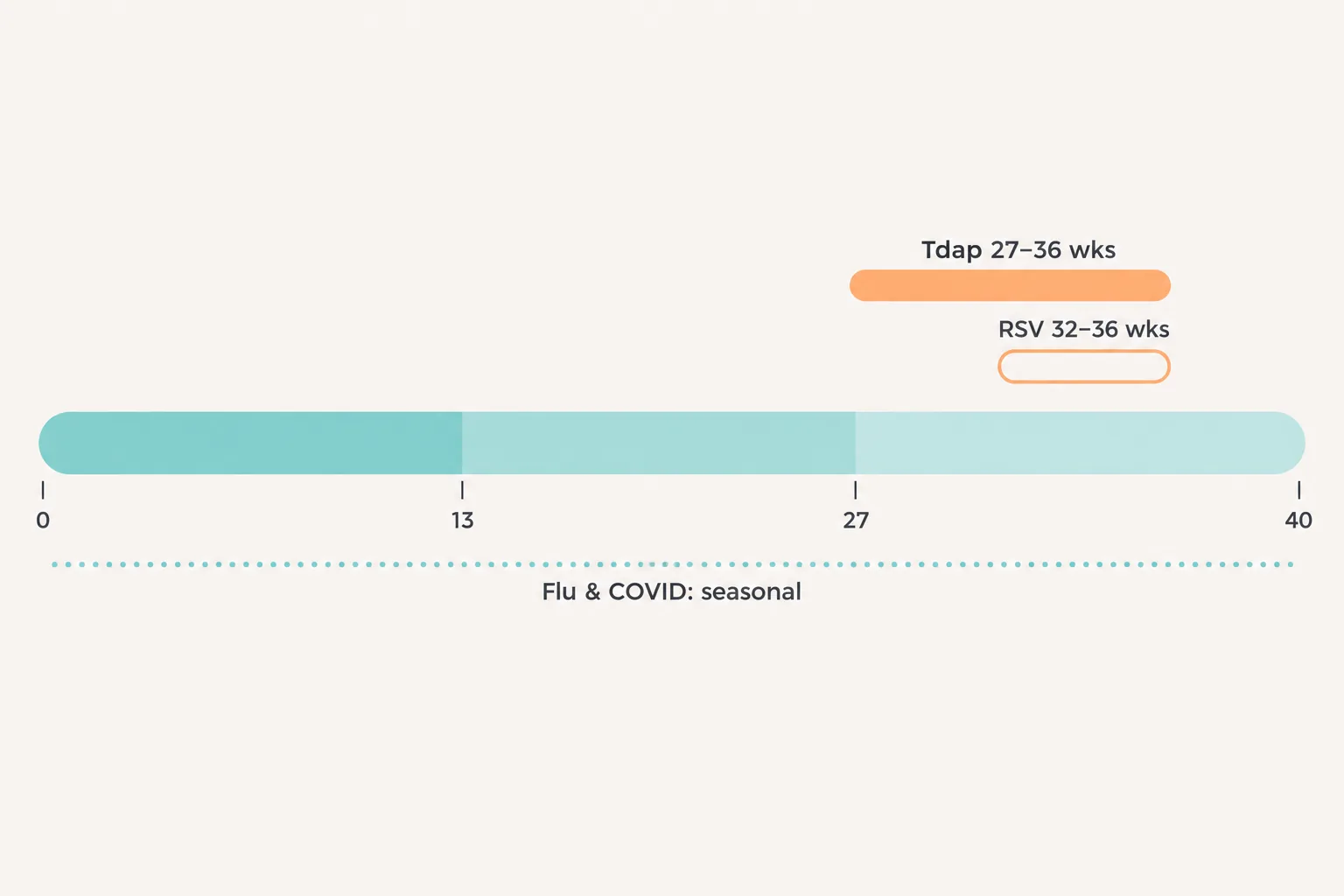
| Vaccine | Usual timing in the U.S. | Main purpose |
|---|---|---|
| Tdap | During every pregnancy, preferably at 27–36 weeks and often earlier in that window. | Passes antibodies to the baby to help protect against pertussis, or whooping cough. |
| Maternal RSV vaccine | Pfizer Abrysvo at 32+0 to 36+6 weeks, during September–January in most of the continental U.S. Eligibility also depends on prior maternal RSV vaccination. | Passes antibodies to the baby for early-life RSV protection. |
| Flu shot | Any trimester while flu viruses are circulating; use the current season’s injectable inactivated or recombinant vaccine. | Helps protect the pregnant person and can help protect the infant. |
| COVID-19 | CDC’s 2026–27 vaccine is recommended for adults 18 and older. Dose and timing depend on age, prior doses, and immune status. | Helps protect the pregnant person; vaccination during pregnancy can also provide some protection to the baby. |
These schedules differ by vaccine. Tdap and maternal RSV have defined late-pregnancy windows to support antibody protection for the newborn; flu and COVID-19 timing follows seasonal and current vaccine guidance.
Do not wait for the third trimester to ask about vaccines that can be given earlier.
Tdap during pregnancy: timing and baby protection
Tdap protects against tetanus, diphtheria, and pertussis, also called whooping cough. Babies are not old enough to start their own pertussis vaccine series until around two months, so antibodies passed during pregnancy help bridge the early weeks.
A dose is recommended during every pregnancy, even if your last Tdap was recent or you received it in a previous pregnancy. The usual window is weeks 27–36, preferably earlier in that window.
You can ask household members and regular caregivers to review their routine vaccines with their own clinicians. This complements, but does not replace, the pregnancy and infant protection plan.
Flu and COVID-19 vaccines during pregnancy
Flu vaccine
Pregnancy can increase the risk of serious influenza illness. During flu season, ask about the injectable inactivated or recombinant flu vaccine. The live nasal-spray flu vaccine is not recommended during pregnancy.
COVID-19 vaccine
As of September 24, 2026, CDC’s 2026–27 COVID-19 guidance recommends a current-season vaccine for all adults age 18 and older, including pregnant adults. ACOG also recommends COVID-19 vaccination during pregnancy. The number and timing of doses depend on age, prior vaccination, and immune status, so confirm the schedule that applies to you.
Vaccination does not guarantee that you will avoid infection. Ask your clinician what protection is expected from the current vaccine and when to receive it.
Maternal RSV vaccine or an antibody for the baby?
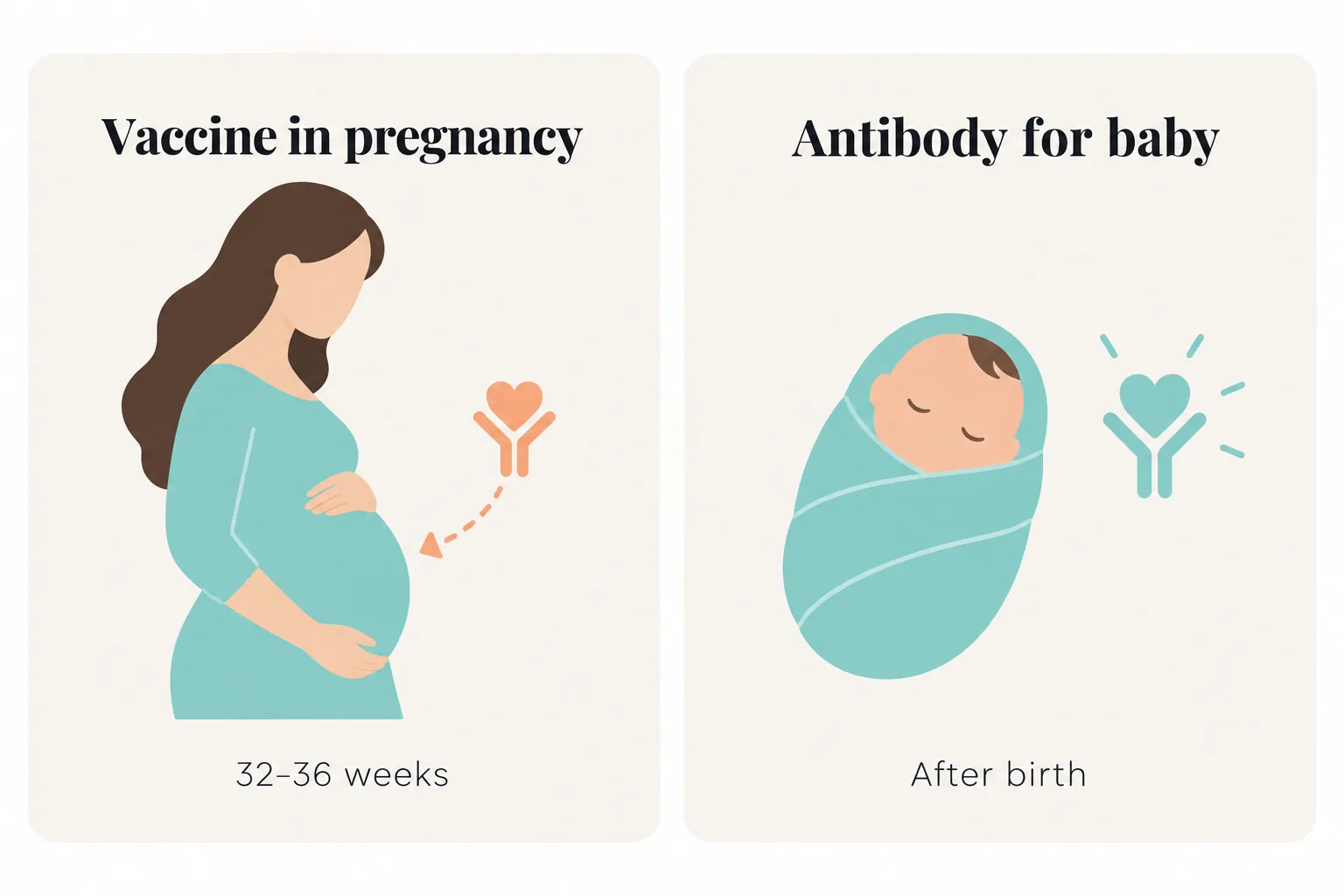
In most of the continental U.S., maternal RSV vaccination uses Pfizer’s Abrysvo at 32+0 through 36+6 weeks during September through January. It takes about two weeks for antibodies to develop and pass to the baby. Abrysvo is the only RSV vaccine recommended for use during pregnancy; the RSV vaccines made for older adults are not pregnancy vaccines.
If you received a maternal RSV vaccine in any previous pregnancy, CDC currently does not recommend another maternal dose in a later pregnancy. The baby should instead be considered for a long-acting RSV antibody. Babies whose mothers did not receive the maternal RSV vaccine during the current pregnancy may also be eligible for an antibody after birth. The available infant antibodies include nirsevimab and clesrovimab. They are monoclonal antibodies, not vaccines.
Most babies are protected through one of these routes, but timing, previous maternal vaccination, and the infant’s health can affect the plan. Review the options with your prenatal clinician and the baby’s clinician. See the CDC’s RSV protection options for infants for current eligibility and timing.
If you have a planned early delivery or are close to the end of the RSV window, ask promptly whether maternal vaccination or infant antibody protection is the better fit.
Vaccines usually postponed during pregnancy
MMR and varicella vaccines are live vaccines and are generally not given during pregnancy. If you are not immune to rubella or chickenpox, ask about vaccination before pregnancy or after delivery. If you received a live vaccine before realizing you were pregnant, contact your clinician for individual advice; an inadvertent dose is not by itself proof that harm occurred. CDC’s pregnancy vaccine guidelines explain vaccine-specific timing and exceptions.
HPV vaccination is also postponed until after pregnancy if a series is not complete. Other vaccines are assessed individually. A vaccine being non-live does not automatically make it appropriate for every pregnancy; health conditions, exposure, travel, age, and vaccine history matter. Hepatitis B vaccination, for example, may be recommended based on vaccination history and current adult guidance.
Side effects and safety questions
Side effects depend on the vaccine. Common short-term effects can include a sore arm, tiredness, headache, muscle aches, or a mild fever. Ask your clinician what to expect from the specific vaccine and what to do if you develop a fever or symptoms that concern you.
Tell your clinician about known allergies and prior reactions to vaccines or medicines so they can check product-specific precautions. Seek emergency care for trouble breathing or swelling of the face or throat after vaccination.
If you have an immune condition, take immune-suppressing medicine, have a history of a severe allergic reaction, or are managing a higher-risk pregnancy, ask your prenatal team to review your vaccine plan rather than relying on a general schedule.
Before and after pregnancy
Before pregnancy, ask whether you are immune to rubella and varicella and whether any vaccines are due. MMR and varicella are live vaccines; CDC advises avoiding pregnancy for 28 days after MMR vaccination and one month after varicella vaccination.
After delivery, a clinician may recommend catch-up vaccination if you are not immune to rubella or varicella. These vaccines are generally compatible with breastfeeding. For help planning recovery and follow-up, see MWC’s postpartum care.
Other vaccines, health conditions, and travel
Vaccines outside the routine pregnancy schedule may be recommended based on a medical condition, exposure risk, age, vaccination history, or travel. If you are planning international travel, raise it early with your clinician or a travel-medicine service so they can consider the destination and vaccine timing. Do not assume that every vaccine is either safe or prohibited based only on whether it is live.
Questions to ask at a prenatal visit
- Which vaccines are due for me now, based on my pregnancy week, prior doses, and the current season?
- Can I receive more than one vaccine at this visit, or is there a reason to space them?
- Am I eligible for maternal RSV vaccination, or should we plan for an antibody for the baby?
- Does my health history, allergy history, or medication list change the recommendation?
- Where should I go for vaccination, and how will the dose be recorded in my medical record?
If a forum post raises a concern, bring the specific question to your prenatal clinician and compare it with current guidance.
Frequently asked questions
Related readingWhat Happens at Your First Prenatal Appointment?Read the guide →Frequently asked questions
Which vaccines are recommended during pregnancy in the U.S.?
When should I get Tdap during pregnancy?
Do I need another maternal RSV vaccine if I had one in a previous pregnancy?
Can I get more than one vaccine at the same visit?
What if I got MMR or varicella vaccine before I knew I was pregnant?
A next step for prenatal care
Bring your vaccine record and questions to a prenatal appointment. If you are considering care with MWC in Minnesota or Wisconsin, review its prenatal care options and care team, and bring questions about vaccines during pregnancy to your visit.
Medical disclaimer: This article is educational and is not personal medical advice. It summarizes U.S. guidance; COVID-19, influenza, and RSV recommendations can change by season. Confirm the current recommendation with your obstetric clinician or midwife.