
If you have just been handed a lab slip and told to drink something very sweet, here is the short answer: the glucose test during pregnancy checks how your body processes sugar. It screens for gestational diabetes, a pregnancy-related form of high blood sugar that usually develops because placental hormones make insulin less effective.
Most patients are screened between 24 and 28 weeks, though some are tested earlier if they have risk factors.
Below is what gets measured, what the test day looks like, what the numbers mean, and what happens if a result comes back high. At MWC Pregnancy, this test is part of personalized prenatal care, so your care team can understand your body’s needs and guide you through the next step with clarity, not fear.
What Does the Pregnancy Glucose Test Actually Measure?
The test measures your body’s response to a known dose of sugar. During pregnancy, hormones from the placenta make your cells less responsive to insulin, the hormone that moves sugar out of your bloodstream and into cells.
Most bodies compensate by producing extra insulin. Some cannot keep pace, and blood sugar climbs. Columbia University Irving Medical Center explains this insulin-resistance mechanism, and it is the exact gap the test is designed to catch.
Two things are worth being clear about. First, this is a screen, not a verdict. It is offered to nearly everyone, so being handed the slip does not mean anyone suspects a problem.
Second, the routine mid-pregnancy glucose test is mainly used to screen for gestational diabetes. It does not screen for birth defects, and it has nothing to do with your anatomy scan. If you have certain risk factors, your provider may also check blood sugar earlier in pregnancy to look for preexisting diabetes or abnormal glucose levels.
Your result helps your provider decide whether routine prenatal care can continue as planned or whether you need a longer glucose tolerance test or extra blood sugar support.
Why Gestational Diabetes Screening Matters for You and Your Baby
Sugar crosses the placenta; insulin does not. When blood sugar runs high, the baby may produce extra insulin and can grow larger than average, which raises the chance of a difficult delivery, shoulder dystocia, cesarean birth, low blood sugar in the newborn, and preterm birth.
For the pregnant parent, it is linked to higher blood pressure, preeclampsia, and a raised lifetime risk of type 2 diabetes.
Will my baby be OK if I have gestational diabetes? In the large majority of cases, yes, when the condition is managed. Most people manage gestational diabetes with nutrition guidance, regular movement, and home blood sugar checks, while some need medication such as insulin or another treatment recommended by their provider.
That is why screening matters. Gestational diabetes is common, often silent, and very manageable once your care team knows it is there.
As the National Institute of Diabetes and Digestive and Kidney Diseases notes, routine screening is important because gestational diabetes is common, often has no obvious symptoms, and can usually be managed well when it is found and treated.
Early screening gives your provider time to guide your care plan, monitor your blood sugar, and support a healthier pregnancy for you and your baby.
Even without a gestational diabetes diagnosis, higher blood sugar levels during pregnancy may still be linked to poorer birth outcomes, …Read on LinkedIn ↗
Two Testing Paths: One-Step and Two-Step
Which test you get depends on your provider, your health history, and the screening approach your clinic uses. A friend’s experience may not match yours, and that does not automatically mean either of you received the wrong test.
The two-step approach
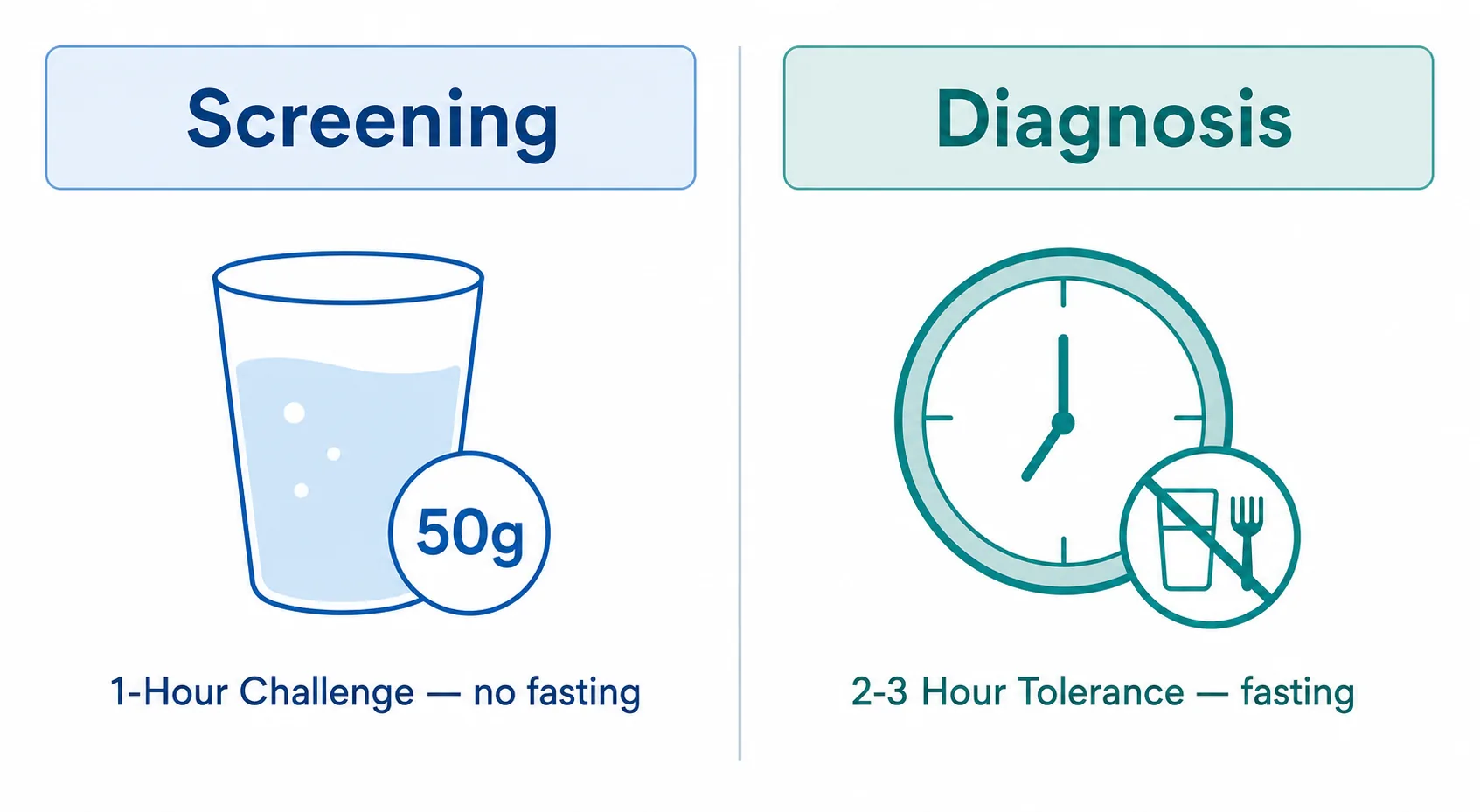
Step one is the 1-hour glucose challenge. You drink a 50-gram glucose solution, usually without fasting, and have one blood draw 60 minutes later. If your number is above the clinic’s cutoff, you move to step two: a fasting 3-hour, 100-gram oral glucose tolerance test with several timed blood draws.
The important point is this: a high 1-hour result usually means you need more testing. It does not automatically mean you have gestational diabetes.
The one-step 75-gram test
The 75-gram glucose tolerance test is a single fasting appointment. You have a baseline blood draw, drink 75 grams of glucose, and then have blood drawn again at one hour and two hours. One elevated value may be enough for a diagnosis, depending on the guideline your clinic follows.
It is commonly used internationally and is also used by some U.S. practices, although the two-step approach remains common in the United States.
Why providers use different approaches
The one-step approach can identify more cases of gestational diabetes, but it may also mean more people receive the diagnosis and the extra monitoring that follows. The two-step approach is more conservative and is still widely used.
A review of updated gestational diabetes screening guidelines explains that screening approaches vary because healthcare systems balance accuracy, patient burden, follow-up testing, and available resources differently. That is why neither approach is simply “wrong,” and why your clinic’s instructions are the ones to follow.
What to Expect on the Day of Your Pregnancy Glucose Test
| What to expect | What it usually means |
|---|---|
| Fasting | Not usually required for the 1-hour screen, but required for the 2-hour or 3-hour glucose tolerance test. Always follow your clinic’s instructions. |
| The drink | You drink a measured sweet glucose solution, usually within about five minutes. |
| Waiting time | You stay at the clinic or lab until your timed blood draw is complete. For longer tests, plan to stay for the full testing window. |
| How you may feel | Some people feel nauseated, warm, sweaty, shaky, or lightheaded. Tell the staff if this happens. |
| If you vomit | The test usually has to be rescheduled. |
A little planning can make test day easier. Bring water if your clinic allows it, something quiet to do while you wait, and a snack for afterward, especially if you are doing a fasting test.
Pregnancy Glucose Test Results: What Numbers Are Considered High?
Thresholds can vary by lab, provider, and guideline, so your care team should always interpret your specific result. A cutoff is the number your clinic uses to decide whether more testing is needed. The numbers below are common reference points, not a substitute for your clinic’s instructions.
| Test | Draw | Common cutoff |
|---|---|---|
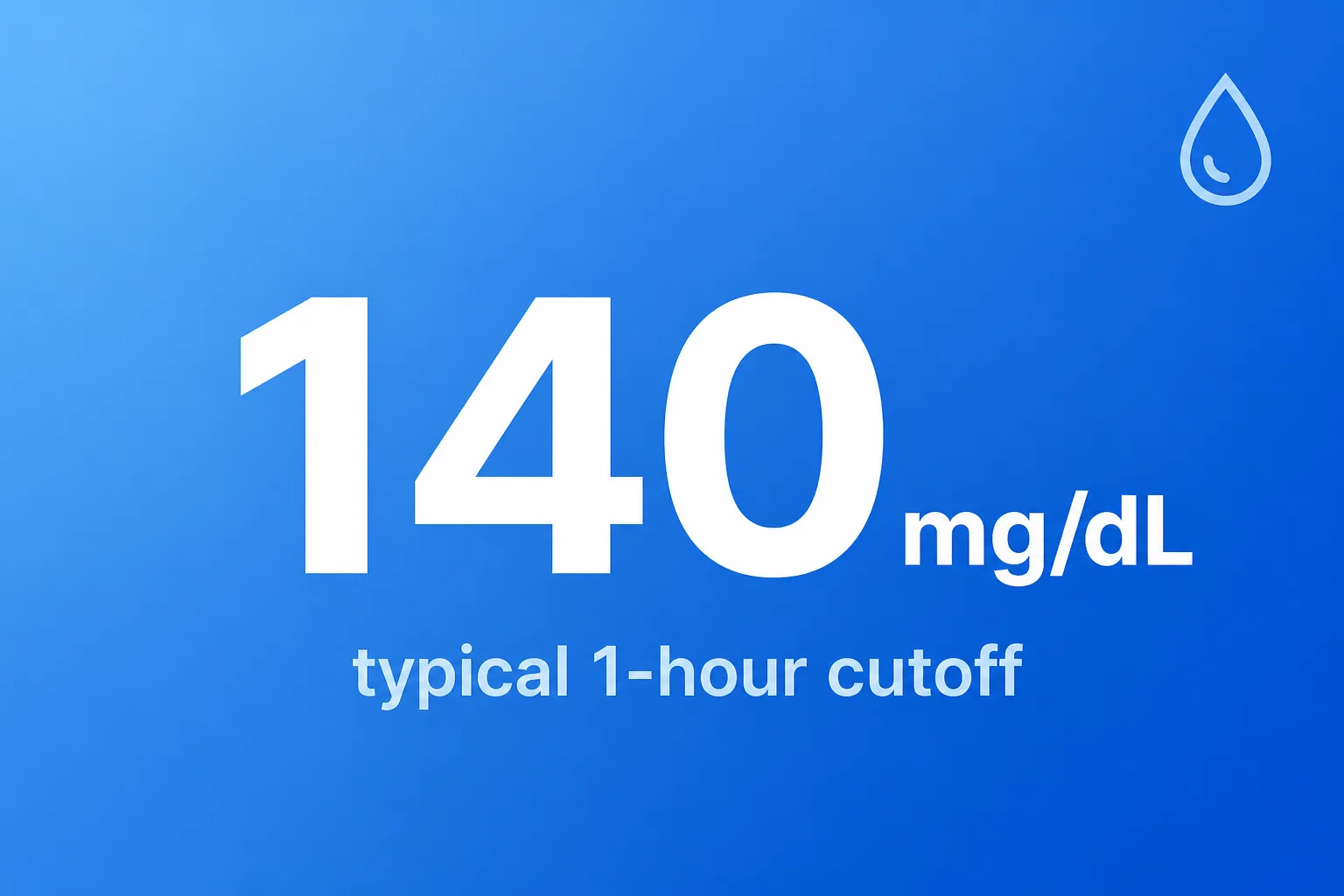
| 1-hour, 50 g screen | 1 hour | 130 to 140 mg/dL |
| 2-hour, 75 g test | Fasting | 92 mg/dL |
| 2-hour, 75 g test | 1 hour | 180 mg/dL |
| 2-hour, 75 g test | 2 hours | 153 mg/dL |
| 3-hour, 100 g test | Fasting | 95 mg/dL |
| 3-hour, 100 g test | 1 hour | 180 mg/dL |
| 3-hour, 100 g test | 2 hours | 155 mg/dL |
| 3-hour, 100 g test | 3 hours | 140 mg/dL |
1-Hour Glucose Test Pregnancy Normal Range
A result under roughly 140 mg/dL is generally considered normal, though many clinics use a lower cutoff near 130 mg/dL to catch more cases. That is why two people with identical numbers can get different instructions.
Going over the cutoff usually means you need the longer glucose tolerance test. It does not automatically mean you have gestational diabetes. Even a slightly high number should be followed up, but it is still a screening result, not a final diagnosis.
2-Hour and 3-Hour Glucose Test Normal Ranges
The rule differs between the two longer tests. On the 75-gram, 2-hour glucose tolerance test, one value at or above the cutoff may be enough for a diagnosis, depending on the guideline your provider follows. In the 100-gram, 3-hour glucose tolerance test, two or more elevated values are typically required for a diagnosis.
Cleveland Clinic publishes commonly used pregnancy glucose test thresholds, including the 1-hour screening range and the 3-hour glucose tolerance test values. Your provider will explain which testing method and cutoff your clinic uses.
If you are unsure what your number means, ask for the exact result, the cutoff your clinic uses, and whether you need any follow-up testing. Your MWC Pregnancy care team can walk you through what the result means for your prenatal care plan.
Are There Signs You Passed Your Glucose Test?
No. There are no reliable physical signs you passed your glucose test, in pregnancy or otherwise, and the myth circulates constantly.
Feeling shaky, sweaty, headachy, tired, or nauseated after the drink is a reaction to a large sugar load hitting your system quickly. It happens to plenty of people with perfectly normal results.
Feeling fine proves nothing either. The only signal is the lab value, usually back within a few days. Some clinics call only if follow-up is needed, but it is always okay to ask for your actual result and the cutoff your clinic uses.
Many people use the phrase “fail the glucose test,” but a high result is not a grade. It is information.
What Can Cause a High Glucose Test Result During Pregnancy?
Mostly physiology, not behaviour. If placental hormones outpace your insulin production, blood sugar rises, and that is largely outside your control.
Recognised risk factors include a previous gestational diabetes diagnosis, family history of type 2 diabetes, higher pre-pregnancy weight, PCOS, older maternal age, previously delivering a large baby, and certain ethnic backgrounds with higher baseline risk.
Situational factors can nudge a single reading: being unwell, some medications such as corticosteroids, or a heavily sugary meal right before a non-fasting screen.
Many people use the phrase “fail the glucose test,” but a high result is not a grade. It is information. A high 1-hour screening result usually means your provider wants a longer test, not that you definitely have gestational diabetes. Plenty of people screen high on the 1-hour test and go on to pass the longer test.
Your care team can explain your number, compare it with your clinic’s cutoff, and help you understand the next step.
How Should You Prepare for the 1-Hour Glucose Test?
The goal is not to trick the test; it is to get an accurate result so your care team can support you if your blood sugar needs attention.
Most 1-hour glucose screens do not require fasting unless your clinic tells you otherwise. Follow your clinic’s instructions exactly. Eat normally in the days before the test, and if you are allowed to eat beforehand, choose a normal balanced meal rather than something very sugary right before your appointment. Drink water if allowed. If your test requires fasting, follow the fasting window your clinic gives you.
Try not to change your eating drastically to “pass.” If your body needs support managing blood sugar, finding that out is the best possible outcome of the appointment.
Can I Refuse the Glucose Test When Pregnant?
Yes. Screening is recommended, not compulsory, and informed refusal is your right.
What you give up is worth weighing. Gestational diabetes is frequently symptomless, so declining removes the main way it gets found. Some providers will discuss alternatives such as an HbA1c, a fasting glucose, or a period of home blood sugar monitoring.
These are not equivalent substitutes, and availability varies. If you are hesitant, have the conversation with your provider rather than quietly skipping the appointment.
How MWC Pregnancy Supports You After a High Glucose Test
Getting a high screening result can feel stressful, but it does not mean you did anything wrong. At MWC Pregnancy, glucose screening is handled as one part of your broader prenatal care plan. Your provider can explain your result, discuss whether a longer test is needed, review nutrition and movement guidance, and help you understand what monitoring may look like if gestational diabetes is diagnosed.
Because MWC Pregnancy offers OB care, midwife care, and personalized pregnancy care options, patients can receive practical support through pregnancy and after delivery. For families in Maplewood, Woodbury, Apple Valley, Hudson, the Twin Cities, and western Wisconsin, that means care does not stop at one lab result.
The goal is to help you feel informed, supported, and confident about the next step, with continued guidance from the MWC Pregnancy care team and support that can continue into postpartum care.
What Happens If You Are Diagnosed With Gestational Diabetes?
A diagnosis can feel stressful, but it does not mean you did anything wrong. Gestational diabetes is common, and once it is found, your care team can help you manage it step by step.
First-line treatment usually starts with nutrition guidance, often with support from a dietitian or prenatal care provider, regular movement, and checking your blood sugar at home with a finger-prick meter.
Your provider will tell you when to check your blood sugar and what target range to follow. Medication, such as insulin or an oral medication recommended by your provider, may be added if blood sugar targets are not met.
You may also have closer monitoring later in pregnancy, which can include growth scans or additional appointments depending on your situation. This can sound overwhelming at first, but the goal is simple: keep you and your baby as healthy as possible.
Gestational diabetes often resolves after birth. Because it can raise your long-term risk of type 2 diabetes, your provider will usually recommend follow-up blood sugar testing in the weeks after delivery and ongoing checks after that.
If you are receiving care through MWC Pregnancy, your care team can guide you through the diagnosis, monitoring, postpartum follow-up, and next steps in your prenatal care plan.
FAQs
Related readingHow Many Prenatal Appointments Do You Have During Pregnancy?Read the guide →Frequently asked questions
What are the warning signs of gestational diabetes?
When is the glucose test done?
Do I have to fast?
Is the glucose drink safe for the baby?
What if I fail the 1 hour but pass the 3 hour?
Can I eat right after?
Final Takeaway
The glucose test measures one thing: how your body handles sugar during pregnancy right now. It exists because gestational diabetes is often silent, common, and highly manageable when it is found.
Ask your provider for your actual numbers, the cutoffs their lab uses, and what the result means for your prenatal care plan.
If you are receiving pregnancy care in Maplewood, Woodbury, Apple Valley, Hudson, the Twin Cities, or western Wisconsin, MWC Pregnancy offers personalized prenatal care, OB and midwife support, advanced screening guidance, and postpartum care to help you feel supported from your first visit through delivery and beyond.
This article is general information, not medical advice. Talk to your midwife, obstetrician, or GP about your own results and care.