
The most important questions to ask at your first prenatal visit cover your due date, how pregnancy was confirmed, your medical history, medication safety, prenatal vitamins, which screening tests are recommended, when your first ultrasound will happen, which symptoms need a call, what to eat and avoid, and who to contact after hours. If you are starting care at MWC, this is also the right time to ask whether OB care, midwife care, or concierge pregnancy care best fits your situation.
In this article, we explore the most important questions to ask at your first prenatal visit, what to expect during the appointment, how to prepare, and how to choose the care model that fits your pregnancy.
The Questions That Matter Most at Your First Prenatal Appointment
The first prenatal appointment is usually longer than the visits that follow it, and that is by design. Your provider needs a full picture of your health, your pregnancy, and your goals before building a care plan. Still, it is easy to walk in with ten questions and walk out having asked only two. That is exactly why a written list helps. Treat this visit as a real conversation, not just a physical exam.
The most useful first prenatal visit questions fall into a few clear areas: your due date, health history, early tests, symptoms, lifestyle habits, medication safety, provider access, and the prenatal appointment schedule going forward. No question is too small when it affects your peace of mind. Pregnancy comes with new rules, new symptoms, and decisions you have never faced before. Your provider expects questions, especially at this stage.
Start with the basics.
Ask, “How far along am I?” and “What is my estimated due date?” Your due date may be calculated from your last menstrual period, an early ultrasound measurement, or a combination of both. If your periods are irregular, if you conceived through fertility treatment, or if your dates are uncertain, ultrasound tends to be the more reliable tool.
It is also reasonable to ask how your pregnancy was confirmed. Some offices confirm with a urine test. Others may order bloodwork to measure hCG levels, especially if there is bleeding, cramping, a history of pregnancy loss, or uncertainty about how far along you are. Ask, “Do I need a blood test today?” and “Will any follow-up test help confirm that the pregnancy is progressing as expected?”
Then move to your medical history.
Ask whether any past surgeries, chronic conditions, family health history, prior miscarriages, fertility treatment, blood pressure issues, thyroid disease, diabetes, clotting disorders, mental health diagnoses, or current medications could change your care plan. Most importantly, ask directly: “Does anything in my history make this a high-risk pregnancy?” If the answer is yes, your provider can explain what extra monitoring or support may be recommended.
Questions About Early Pregnancy Testing and Lab Work
Testing is a significant part of the initial prenatal visit. Early pregnancy lab work often includes blood type and Rh factor, complete blood count, urine tests, urine culture, and screening for certain infections. The American College of Obstetricians and Gynecologists notes that routine early pregnancy labs include CBC, blood type and Rh factor, urinalysis, and urine culture.
Ask which screening tests are routine, which are optional, and when results will be ready. A clear question works well here: “Which blood tests during the first trimester do you recommend for me specifically, and why?” Another worth asking: “Should I consider genetic screening or non-invasive prenatal testing?” MWC provides detailed patient information on non-invasive prenatal testing options for patients who want to understand what NIPT can and cannot tell them before deciding.
At MWC, the conversation around testing is always guided by your situation; not every patient needs every test, and no one should feel pressured into screenings that do not align with their values or circumstances. That kind of honest, individualized approach is part of what makes care here feel different.
Ask about ultrasound timing too. Many patients want to know: will I see an ultrasound at the first visit? The honest answer is sometimes. It depends on how far along you are, your symptoms, your health history, and the clinic’s approach. Ask, “Will I have an ultrasound today, or will it be scheduled separately?” and “What can we expect to see at my current stage?” If it is very early, there may not be much visible yet, and that does not automatically mean something is wrong.
| Part of the visit | What may happen | Question to ask |
| Pregnancy confirmation | Urine test, blood test, due date estimate, review of last menstrual period | How far along am I, and how was my due date calculated? |
| Health history | Review of conditions, medications, surgeries, prior pregnancies, family history | Does anything in my history change my pregnancy care plan? |
| Physical exam | Weight, blood pressure, pelvic exam, breast exam, Pap smear if due | Do I need a Pap smear while pregnant, or can it wait? |
| Lab work | CBC, blood type and Rh factor, urine culture, infection screening | Which tests are routine, and when will I get results? |
| Ultrasound | May happen at this visit or be scheduled separately | Will I have a first ultrasound today or at a later appointment? |
| Care planning | Prenatal vitamin, symptoms, visit timing, screening choices, next steps | What should I do before my next prenatal check-up? |
Questions About Medications, Prenatal Vitamins, and Lifestyle
Medication questions are among the most important ones to ask at the first prenatal visit. Bring every prescription, supplement, herbal product, and over-the-counter medication you currently take, or take photos of the labels. Ask directly: “Are my current medications safe during pregnancy?” and “Which over-the-counter options are safe for headaches, allergies, nausea, constipation, or heartburn?”
Do not stop any prescribed medication without guidance, especially for blood pressure, thyroid disease, seizures, diabetes, depression, anxiety, or other ongoing conditions. Changes need to be made with your provider, not on your own.
Prenatal vitamins deserve a direct question too. Ask which prenatal vitamin your provider recommends, whether you need added iron or DHA, and how much folic acid is appropriate. The CDC states that getting 400 micrograms of folic acid daily can help prevent serious neural tube defects, and that matters especially in early pregnancy, because the neural tube develops very early, sometimes before a woman even knows she is pregnant.
Lifestyle questions belong here as well. Ask about foods and drinks to avoid, safe caffeine limits, seafood guidelines, nausea management, whether sex is safe, whether your current exercise routine needs modification, and how to handle travel, dental appointments, vaccines, and work demands. According to the Mayo Clinic, first-trimester prenatal care conversations typically cover exercise, sex, dental visits, vaccinations, travel, work environment, and medication use, so none of these questions are unusual or out of place.
When Should You Schedule Your First Prenatal Visit?
After a positive pregnancy test, call a provider rather than waiting until you “feel ready.” Most offices schedule the first prenatal visit around 8 to 10 weeks of pregnancy, but the right timing depends on your health history and early symptoms.
ACOG’s guidance supports offering an initial prenatal assessment before 10 weeks from the last menstrual period, or within a reasonable timeframe after pregnancy is confirmed. But that does not mean everyone should wait. If you have severe one-sided pelvic pain, heavy bleeding, shoulder pain, fainting, persistent vomiting, fever, a history of ectopic pregnancy, prior pregnancy loss, diabetes, high blood pressure, clotting disorders, or fertility treatment, call sooner.
Many people search “what to do when you find out you’re pregnant” or “first doctor appointment after positive test” because the early days feel genuinely confusing. Here is the practical answer: start a prenatal vitamin if you have not already, avoid alcohol and smoking, review any medications with a health professional, write down your last menstrual period date, and schedule care.
If you are near Maplewood, Woodbury, Apple Valley, Hudson, St. Paul, or anywhere in the Twin Cities area, scheduling your first prenatal visit with MWC Pregnancy takes only a few minutes, and it puts you in contact with a care team that prioritizes listening before it starts leading.
Is 10 or 12 Weeks Too Late to Start Prenatal Care?
A first prenatal visit at 10 weeks is common across many practices. A 12-week first appointment can also fall within normal care, particularly if a patient called later, transferred from another provider, had scheduling delays, or did not know they were pregnant right away. That said, earlier is better; some screening windows are time-sensitive, and certain decisions work best with more lead time.
If you are wondering whether 10 or 12 weeks is too late, the answer is usually no, but the important step is to schedule care now and let your provider assess what needs attention first. Patients should never feel embarrassed about the timing of their first appointment. Cycles are irregular. Life gets complicated. Symptoms can be vague. A good care team will not make you feel judged for starting when you did.
At the 12-week appointment, your provider will typically review your due date, check blood pressure and weight, discuss any lab results, listen for fetal heart tones when appropriate, and talk through screening choices. Some patients may also have ultrasound or first-trimester testing around this stage depending on the care plan.
Prenatal Visit Schedule: How Often Do You See the Doctor?
A prenatal appointment schedule is not identical for every patient. Traditional care generally involves visits about every four weeks in early pregnancy, every two weeks later in the third trimester, and weekly near the end. Newer guidance favors more individualized scheduling, one that reflects health risks, patient needs, and access to care rather than a rigid formula.
ACOG’s current clinical guidance supports a more patient-centered prenatal care model, and that fits naturally with how MWC approaches pregnancy: structured care that still makes sense for the individual in the room, your pregnancy, your way.
| Pregnancy stage | Common visit pattern | What is usually discussed |
| Positive test to first visit | Call soon after confirmation | Symptoms, medications, early risks, appointment timing |
| First trimester | Often every 4 weeks, based on risk | Due date, labs, ultrasound, genetic screening, nausea, prenatal vitamins |
| 14 to 28 weeks | Often every 4 weeks | Growth, anatomy scan, blood pressure, urine checks, symptoms |
| 28 to 36 weeks | Often every 2 weeks | Glucose screening, fetal movement, birth planning, warning signs |
| 36 weeks to delivery | Often weekly | Labor signs, Group B strep, delivery preferences, postpartum prep |
What to Bring to Your First Pregnancy Appointment
Preparation does not need to be complicated, but a few details make a real difference. Bring your last menstrual period date if you know it, your insurance card, photo ID, full medication and supplement list, allergy information, and any records from prior pregnancies, fertility treatment, surgeries, or recent labs. If you track your cycle in an app, have it open before you arrive.
A written list of questions is worth more than most people expect. Pregnancy appointments move quickly once labs, symptoms, and scheduling enter the conversation. Write down the things that feel silly to ask; those are often the ones that keep people awake later. Ask about nausea, weight gain, sleep, exercise, sex, coffee, travel, hair care, dental work, work duties, and what to do when anxiety spikes.
If your partner or support person is coming, have them write their questions down too. Partners frequently remember everything the moment they reach the parking lot. Better to have the list in hand.
| Bring this | Why it helps |
| Last menstrual period date | Helps estimate gestational age and due date |
| Medication and supplement list | Helps your provider check safety and dosage |
| Medical and pregnancy history | Helps identify risks early and adjust the care plan |
| Family health history | Helps guide genetic screening and counseling decisions |
| Insurance card and photo ID | Helps with labs, referrals, and visit processing |
| Symptom notes | Helps clarify nausea, bleeding, cramping, headaches, or fatigue |
| Written questions | Helps you remember what matters before the visit ends |
Questions for Partners and Dads at the First Prenatal Appointment
Partners often want to help but are not sure where they fit in, especially at the first prenatal visit. That is understandable. Pregnancy happens in one body, but the support around that body can shape the entire experience.
A partner can ask practical, useful questions: “What symptoms should we watch for at home?” and “When should we call the office instead of waiting?” Another good one: “How can I help with nausea, fatigue, food aversions, mood shifts, or appointment anxiety during the first trimester?”
If this is a first pregnancy, partners may also want to ask about the prenatal appointment timeline, when the first ultrasound happens, childbirth education options, hospital planning, postpartum recovery, and what support person policies look like during labor. MWC offers postpartum care and recovery support because care should not stop the moment the baby arrives, and starting that conversation early means both parents feel less blindsided later.

Questions About Choosing Your Care Model: OB, Midwife, or Concierge
Choosing a provider is one of the most meaningful early pregnancy decisions. Some patients want an OB-GYN. Others prefer midwife care. Some want a model built on continuity, a longer, closer relationship with the same provider through delivery.
Ask directly: “What type of maternity care fits my pregnancy best?” and “Can I choose between OB and midwife care?” If you want more personal support throughout, ask what concierge pregnancy care involves and whether you would see the same physician for prenatal visits and delivery.
MWC’s care model is built entirely around this kind of choice. Patients can explore OB, midwife, and concierge pregnancy care options based on their preferences and medical needs, and that is a meaningful difference from practices where patients simply see whoever is available. Your pregnancy. Your way.
Ask who will deliver your baby. In some practices, the person who sees you for prenatal care may not be on call when labor begins. That may be fine for you, or it may not. Knowing early helps. A direct question is best: “Will my prenatal provider also be involved in my delivery?”
You can also ask what happens if your pregnancy becomes higher risk. Does the practice coordinate with specialists? Would your care team stay consistent? Patients who want to understand provider backgrounds and team structure can meet the full MWC pregnancy care team.
Birth planning does not need to happen at the first visit, but early values matter. If you care about pain management options, movement during labor, induction timing, delayed cord clamping, breastfeeding, skin-to-skin care, or who is in the room, mention it early. You do not need a perfect birth plan yet; you just need a provider who genuinely listens.
Questions About Prenatal Testing, NIPT, and Ultrasound
Prenatal testing can feel like alphabet soup quickly. CBC, Rh factor, NIPT, STI screening, urine culture, anatomy scan, glucose test. The first prenatal visit is the right time to ask what each test actually does and whether it is routine, recommended, optional, or specific to your history.
Ask first: “Which prenatal screening tests are recommended for everyone?” Then ask: “Which tests are based on my age, family history, ethnicity, prior pregnancies, or personal preference?” That second question matters because not every patient needs every test, and not every test provides the same type of information.
Non-invasive prenatal testing, or NIPT, is a blood test that screens for certain chromosome conditions. It is not the same as a diagnostic test, so ask what an abnormal result would mean and what follow-up would look like. MWC offers a deeper patient guide to NIPT and genetic testing during pregnancy for patients who want to understand the options before making any decisions.
Ultrasound questions are equally common. Do you get an ultrasound at the first prenatal visit? Sometimes. If the visit is early, the scan may confirm the pregnancy is in the uterus and estimate gestational age. If timing is uncertain, a repeat scan may be more useful than drawing early conclusions. Your provider should explain the plan and what each scan can and cannot tell you at that stage.
The clearest question to anchor this whole section: “What will this test tell us, and what would we actually do with the result?” That one sentence can turn a confusing lab order into an informed, confident decision.
Questions About Comfort, Morning Sickness, and Whole-Body Support
Pregnancy care is not only about lab values and due date math. It is also about getting through Tuesday when your stomach turns at the smell of toast, your back aches through the afternoon, and your mind will not settle at night. Good prenatal care makes room for those realities.
Ask how to manage morning sickness before it becomes severe. Ask what to do if you cannot keep fluids down, when nausea needs treatment, and whether vitamin B6, dietary adjustments, or prescription options may help. If you have headaches, constipation, heartburn, pelvic pressure, insomnia, anxiety, or mood shifts, bring them up early. Toughing it out is not a requirement of good patience.
At MWC, that whole-body perspective is built directly into the care model. Alongside prenatal medical visits, patients have access to pelvic floor physical therapy, chiropractic care, functional medicine, and acupuncture, because pregnancy changes posture, digestion, joints, sleep, hormones, and stress levels all at once. A full-body experience deserves full-body support.
For patients who want comfort alongside clinical care, PamperSuite brings pregnancy-safe spa and wellness services into the experience, not as a luxury for luxury’s sake, but because feeling physically supported during pregnancy genuinely affects sleep, movement, mood, and confidence. If your back or hips already hurt, ask whether pregnancy-safe chiropractic care is appropriate. If nausea, stress, or headaches are interfering with daily life, ask about acupuncture or functional medicine support through MWC’s innovations in care.
Pelvic floor questions belong here too, even in the first trimester. Many patients wait until pain, leaking, or postpartum difficulty forces the conversation. Asking early is better: “Should I see a pelvic floor physical therapist during pregnancy?” and “How can I prepare my body for labor and recovery?” Those questions are especially relevant for patients with pelvic pain, prior birth trauma, urinary leakage, constipation, back pain, or delivery recovery concerns. Comfort is not optional during pregnancy. It affects everything else.
First Prenatal Visit Questions Checklist
You do not need to cover every question below in a single appointment. Pick the ones that fit your situation and save the rest for later visits.
| Category | Questions to ask |
| Due date | How far along am I? What is my due date? Could an ultrasound change it? |
| Pregnancy confirmation | How was pregnancy confirmed? Do I need bloodwork today? |
| Health history | Does anything in my medical history make this a high-risk pregnancy? |
| Medications | Are my prescriptions, supplements, or OTC medications safe during pregnancy? |
| Prenatal vitamin | Which prenatal vitamin do you recommend? Do I need iron, DHA, or extra folic acid? |
| Testing | Which screening tests do you recommend, and when will results be ready? |
| Ultrasound | When will I have my first ultrasound during pregnancy? |
| Symptoms | Which symptoms are expected, and which ones mean I should call right away? |
| Food and drinks | What foods, drinks, and supplements should I avoid? |
| Weight | How much weight gain is expected given my health and starting point? |
| Lifestyle | Can I exercise, travel, have sex, and continue my usual work? |
| Appointments | What is my prenatal visit schedule from here? |
| Provider access | Who do I reach after hours if something feels wrong? |
| Birth planning | Who may deliver my baby, and when do we talk about labor preferences? |
| Postpartum | What support is available for recovery, mood, feeding, and pelvic floor after delivery? |
If you are nervous, copy this table into your phone or print it before you go. No one ever regretted having the question written down when the provider asks, “What else can I answer for you?”
FAQs About the First Prenatal Visit
What is a prenatal visit?
A prenatal visit is a pregnancy care appointment with a health care provider. Prenatal means “before birth,” so prenatal care covers the monitoring, testing, guidance, and support you receive during pregnancy. A routine prenatal visit typically includes blood pressure, weight, urine testing, fetal heart rate checks in later pregnancy, symptom review, and time for your own questions.
When is the first prenatal visit usually scheduled?
Most patients have their first prenatal visit around 8 to 10 weeks of pregnancy. However, the right move is to call soon after a positive test. Some patients need earlier appointments because of bleeding, pain, severe nausea, fertility treatment, prior pregnancy loss, or ongoing health conditions.
What type of doctor do you see during pregnancy?
Many patients see an OB-GYN. Others choose a certified nurse-midwife or a family medicine physician who provides maternity care. High-risk pregnancies may also involve a maternal-fetal medicine specialist. At MWC, patients can talk through their preferences and choose the care model- OB, midwife, or concierge- that fits their needs and their life.
Do you get a Pap smear when pregnant?
You may, if you are due for cervical cancer screening or if your provider recommends it based on your history. If you are unsure why it is being offered, ask. Your provider should explain the reason, describe what the exam involves, and confirm whether it can be deferred.
Do you get an ultrasound at the first prenatal visit?
Sometimes. Some patients have an early ultrasound at the first appointment, while others have it scheduled separately. Timing depends on gestational age, symptoms, medical history, and the clinic’s standard approach.
Can I eat before my first prenatal visit?
Usually yes. Most first prenatal appointments do not require fasting unless your clinic provides specific instructions for a blood test. If you are unsure, call ahead and ask.
How long does the first OB-GYN appointment take?
Longer than a routine visit. The first prenatal appointment typically includes medical history review, due date estimation, lab orders, a physical exam where indicated, symptom discussion, and care planning. Plan for extra time so you do not feel rushed through any part of it.
What happens at a pregnancy confirmation appointment?
A pregnancy confirmation appointment usually includes a urine pregnancy test, blood test if indicated, review of your last menstrual period, symptom check, medication review, and a discussion of next steps. Depending on timing and symptoms, an ultrasound may be scheduled or performed at the same visit.
Can I skip prenatal appointments?
It is strongly advisable not to skip without speaking to your provider first. Prenatal visits monitor blood pressure, fetal growth, lab results, symptoms, and possible complications. If scheduling is difficult because of work, childcare, or cost, tell your care team. A modified plan may be possible.
Do partners or dads go to the first prenatal appointment?
Yes, many partners attend; policies can vary by office. A partner can help take in information, ask questions, and learn warning signs. If someone is coming with you, check the clinic’s support person guidelines before the visit.
Start Your Pregnancy With a Team That Actually Listens
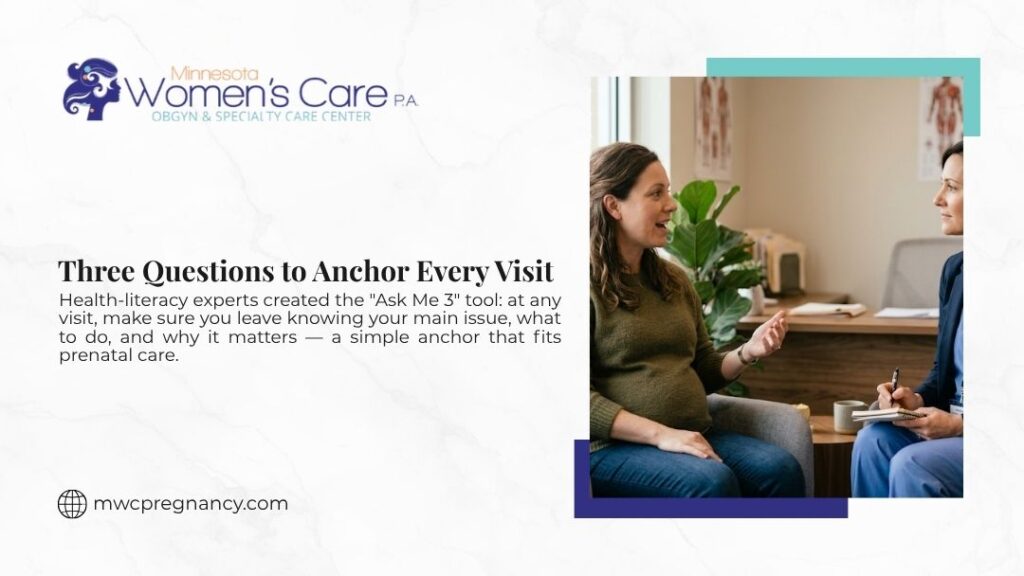
Knowing what questions to ask at first prenatal visit changes the experience. Instead of sitting quietly and hoping everything is fine, you participate in the conversation. You ask about your due date, symptoms, test options, prenatal vitamins, medication safety, provider access, and the kind of birth support you want. You leave with a clearer head.
That kind of appointment matters. Pregnancy is not only a medical event, but it is also a physical, emotional, and deeply personal season. You deserve a team that explains clearly, listens without rushing, and supports your choices without making you feel like a number moving through a system.
Start with a visit where your questions, symptoms, birth preferences, and care options all have room on the table. MWC Pregnancy offers OB care, midwife care, concierge options, advanced screening conversations, whole-body wellness support, hospital-based labor and delivery, and postpartum recovery services, all across four locations serving Maplewood, Woodbury, Apple Valley, Hudson, and the wider Twin Cities region.