
First-trimester prenatal tests usually include routine bloodwork, a urine test, blood type and Rh factor testing, infection screening, immunity checks, and optional genetic screening such as NIPT or combined first-trimester screening.
These tests help your care team understand your health, check for early pregnancy concerns, and give you choices about how much genetic information you want during the first trimester.
This guide helps you understand which first-trimester prenatal tests are routine, which ones are optional, when they usually happen, and what your results may mean so you can walk into your first prenatal visit feeling more prepared, less overwhelmed, and ready to make informed decisions with your prenatal care team.
When Do First-Trimester Prenatal Tests Happen? (Week by Week)
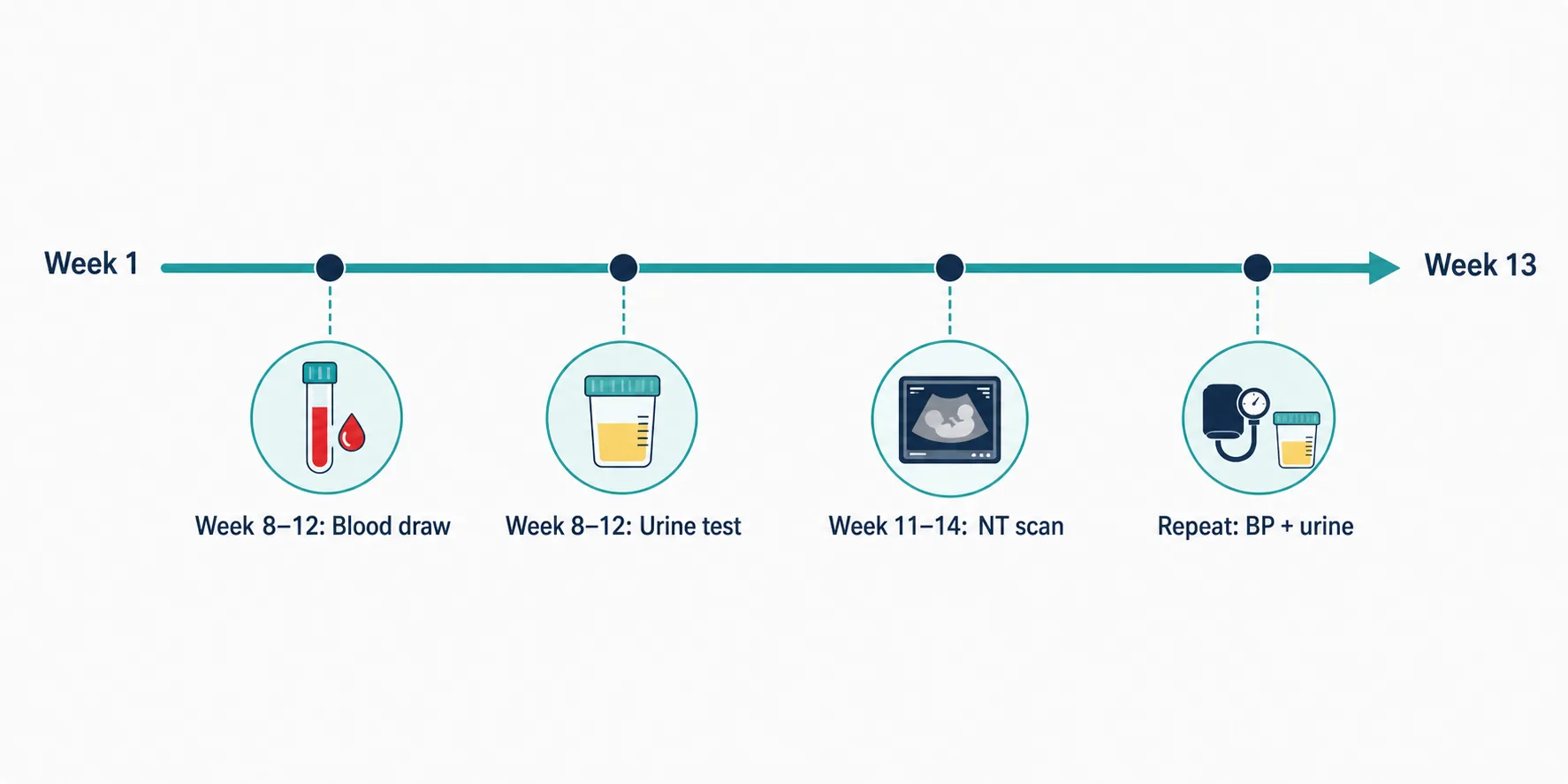
Most first-trimester testing clusters around a few points:
- Weeks 8–12: Your first prenatal visit, where the bulk of routine bloodwork and a urine sample are collected.
- Week 10 and later: Optional cell-free DNA screening (NIPT) becomes available.
- Weeks 11–13: The combined screening, which pairs a blood test with a nuchal translucency ultrasound.
Some tests are standard for everyone; genetic screenings are a personal choice. Mayo Clinic’s overview of prenatal testing explains how screening tests differ from diagnostic ones and when each is offered.
| Timing | Common test or screening | Routine or optional |
|---|---|---|
| First prenatal visit, often 8–12 weeks | Bloodwork, urine test, blood type/Rh factor, infection screening, immunity checks | Routine |
| 10 weeks and later | Cell-free DNA screening / NIPT | Optional |
| 11–13 weeks | Nuchal translucency ultrasound with bloodwork | Optional screening |
| If screening shows higher risk | CVS or other diagnostic discussion | Diagnostic option, not routine |
Routine First-Trimester Blood Tests
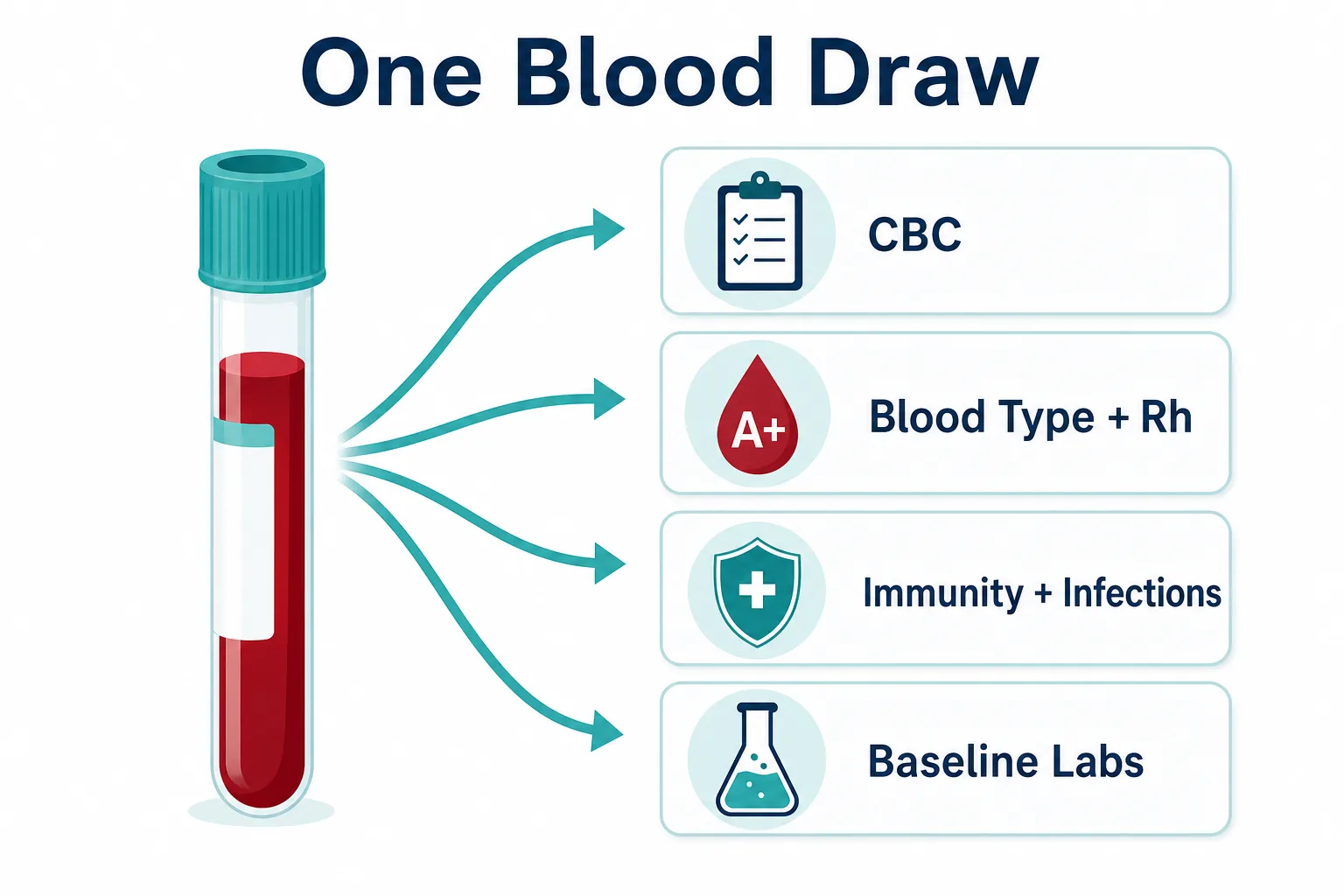
Early in pregnancy, your provider draws blood to establish a baseline and catch anything that needs support or closer follow-up. A typical first-trimester blood panel may include:
| Test | What it checks |
|---|---|
| Complete blood count, or CBC | Screens for anemia, infection markers, and platelet levels |
| Blood type and Rh factor | Identifies whether Rh incompatibility needs to be planned for |
| Rubella and varicella immunity | Confirms protection against German measles and chickenpox |
| Hepatitis B, HIV, and syphilis screening | Checks for infections that can affect pregnancy care |
| Thyroid or glucose testing | Added when your health history suggests a need |
Routine first-trimester labs are a standard part of early prenatal care. ACOG explains that routine pregnancy testing commonly includes blood type and Rh factor testing, urine testing, and infection screening, while MedlinePlus lists CBC, blood type/Rh screen, rubella screening, syphilis testing, and HIV testing as part of the first-trimester prenatal panel.
For a deeper look at what may happen during that first visit, what happens at your first prenatal appointment covers the key steps and expectations.
How Many Blood Tests Will I Have in the First Trimester?
Fewer draws are usually needed than the long list of tests may suggest. Most first-trimester labs are bundled into one blood draw at your first prenatal visit, rather than separate needle sticks for every item.
At the same appointment, you will usually also provide a urine sample, which helps check for signs of infection, protein, sugar, or other findings your provider may want to monitor.
Follow-up bloodwork may be recommended later depending on your health history, symptoms, previous results, or pregnancy risk factors. For example, glucose screening is usually done later in pregnancy, often around weeks 24–28, unless your provider has a reason to check earlier.
Your care team can explain what to expect from the blood and urine tests at your first prenatal appointment and how your testing schedule fits into the bigger picture of how many prenatal appointments happen during pregnancy.
Urine Tests During the First Trimester
At your first prenatal visit, you will usually give a urine sample. A urinalysis can check for signs such as protein, sugar, hydration status, or possible infection.
A urine culture may also be used to look for a urinary tract infection or asymptomatic bacteriuria, which means bacteria are present even if you do not feel symptoms.
This matters because some infections during pregnancy are quiet at first. Finding them early gives your provider a chance to treat them before they cause bigger concerns.
First-Trimester Screening for Chromosomal Conditions and Birth Defects
First-trimester screening can give you more information about the chance of certain chromosomal conditions and some early developmental concerns. These tests are optional, and choosing them is a personal decision your prenatal care team can help you understand.
The combined screening (11–13 weeks)
Combined first-trimester screening is usually done between 11 and 13 weeks. It pairs a maternal blood test (measuring PAPP-A and hCG) with a nuchal translucency ultrasound, which measures fluid at the back of the baby’s neck.
Together, these results estimate the chance of chromosomal conditions such as Down syndrome, trisomy 18, and trisomy 13.
This screening can give your provider more information early in pregnancy, but it is not a diagnosis. If the result shows a higher chance of a chromosomal condition, your provider may talk with you about genetic counseling, additional ultrasound review, or diagnostic testing options.
Cell-Free DNA Screening / NIPT
Available from about 10 weeks, this blood test analyzes cell-free DNA from the placenta that circulates in your bloodstream and screens for a higher or lower chance of common chromosomal conditions.
NIPT is often chosen because it can be done with a blood draw and has strong screening performance for common trisomies. Still, it is important to remember that it is not diagnostic. A low-risk result can be reassuring, while a higher-risk result usually means more conversation and possibly more testing.
Non-invasive prenatal testing can help clarify how this type of screening fits into early pregnancy care and what to expect during the process.
Screening vs. diagnostic
Screening tests estimate risk, while diagnostic tests can confirm whether a condition is present. First-trimester screening may include NIPT, maternal blood screening, or ultrasound-based screening, but these results are not a final diagnosis.
Related readingGenetic Testing During Pregnancy: Non-Invasive Prenatal Testing (NIPT) – MWC PregnancyRead the guide →Screening tests estimate risk, while diagnostic tests can confirm whether a condition is present.
According to StatPearls’ review of prenatal genetic screening, prenatal screening evaluates the risk of a fetus having a specific genetic disorder, while prenatal diagnostic testing is used to confirm the presence of a genetic condition. ACOG also notes that a positive cell-free DNA screening result should be followed by genetic counseling and diagnostic testing, such as chorionic villus sampling (CVS) or amniocentesis.
Diagnostic testing is usually discussed when a screening result comes back higher risk, when ultrasound findings need closer evaluation, or when family history suggests the need for more information. This is why your provider may talk with you about your results, your options, and what each next step can and cannot tell you.
You can also explore the types of prenatal screenings and personalized care options available through a dedicated prenatal care team.
Understanding Your First-Trimester Screening Results
Results arrive as a risk ratio, such as 1 in 1,500, not a simple yes or no. A “screen positive” result means higher-than-average risk and warrants follow-up; it does not confirm a diagnosis. As the CDC’s guidance on screening for birth defects notes, most people with a screen-positive result go on to have healthy babies. Your provider is the best person to interpret your specific numbers.
A low-risk result can be reassuring, but it also does not guarantee that every condition has been ruled out. If your result is higher risk, your care team may recommend genetic counseling, a follow-up ultrasound, or diagnostic testing so you can make the next decision with clearer information.
What Happens If a First-Trimester Screening Comes Back Higher Risk?
A higher-risk screening result does not mean your baby has a condition. It means your provider may recommend a more detailed conversation, genetic counseling, a follow-up ultrasound, or diagnostic testing such as CVS or amniocentesis.
This is where personalized guidance matters, because the next step depends on the type of result, your pregnancy history, and what information you want before making decisions.
This is also where the right care environment matters. You should not be left alone with numbers, ratios, or confusing lab language. A good prenatal care team will explain what the result means, what it does not mean, and which options are available next.
Routine vs. Optional First-Trimester Prenatal Tests
Routine tests are generally recommended for everyone because they check your health and look for issues that may affect pregnancy care. Optional screenings are different.
They help estimate your baby’s chance of certain genetic or chromosomal conditions, but they are guided by your values, comfort level, age, history, and the type of information you want.
| Test type | Usually routine or optional? | Main purpose |
|---|---|---|
| CBC | Routine | Checks anemia, infection markers, and platelet levels |
| Blood type and Rh factor | Routine | Helps plan care if Rh incompatibility is possible |
| Rubella/varicella immunity | Routine | Confirms protection against certain infections |
| HIV, hepatitis B, syphilis screening | Routine | Supports early treatment and pregnancy planning |
| Urine testing | Routine | Screens for protein, sugar, and infection signs |
| NIPT / cell-free DNA screening | Optional | Screens for higher or lower chance of certain chromosomal conditions |
| Nuchal translucency ultrasound with bloodwork | Optional screening | Estimates risk for certain chromosomal conditions |
| CVS or amniocentesis | Diagnostic option | Confirms certain genetic or chromosomal conditions |
Bringing a short list of questions to ask about prenatal testing, NIPT, ultrasound, and follow-up results can make the decision easier. You can use this guide on what questions to ask at your first prenatal visit to prepare before your appointment.
The right choice is the one you make with clear information, your values, and guidance from your prenatal care team.
Questions to Ask at Your First Prenatal Visit
If you are unsure which first-trimester tests you need, bring your questions with you. A short list can make the appointment feel less rushed and more useful.
| Question | Why it helps |
|---|---|
| Which tests are routine for me? | Helps you understand what standard prenatal care is |
| Which tests are optional? | Makes screening choices clearer |
| What does NIPT screen for? | Prevents confusion between screening and diagnosis |
| What happens if a result is higher risk? | Helps you feel prepared instead of surprised |
| Will my insurance cover these tests? | Reduces billing surprises |
| Should my health history change the testing plan? | Helps personalize your care |
| Who will explain my results? | Gives you a clear follow-up path |
First-Trimester Prenatal Testing With MWC Pregnancy
At MWC Pregnancy, first-trimester testing is part of a personalized prenatal care plan. Your care team can help you understand which tests are routine, which screenings are optional, and what each result may mean for your pregnancy.
Whether you choose OB care, midwife care, or a more personalized care model, the goal is the same: clear answers, supportive guidance, and care that fits your pregnancy.
This approach is especially helpful in the first trimester, when everything can feel new, emotional, and full of decisions. Instead of treating testing as a checklist, your care team can help you understand how each step fits your health, your baby’s development, and the kind of pregnancy experience you want.
If you are looking for personalized pregnancy care in Minnesota or western Wisconsin, MWC Pregnancy offers prenatal care options designed to support you from the first visit through delivery and beyond. You can learn more about pregnancy care, prenatal care, and your care options.
Frequently asked questions
How many blood tests will I have in the first trimester?
Can a first-trimester blood test detect abnormalities?
Do I have to get every prenatal test?
Is NIPT done in the first trimester?
What should I do if my screening result is higher risk?
Start First-Trimester Care With Clear Answers
Every pregnancy is different, and your first-trimester testing plan should reflect your health history, your questions, and the kind of support you want.
If you are ready to start prenatal care or want help understanding your testing options, contact MWC Pregnancy to schedule a visit with a care team that can guide you through the first trimester with clarity and support.