

After a positive pregnancy test, you may be asked to choose between a family medicine doctor and an OB-GYN for prenatal care. If you are weighing a family medicine doctor vs OB for pregnancy, compare the clinician’s maternity training, the services the practice offers, your health history, and who can attend the birth. Both types of clinicians may provide prenatal care, but not every family physician offers obstetrics, and the person you see in clinic may not be the person on call when you deliver.
Quick answer: family medicine doctor vs OB for pregnancy

An OB-GYN is a physician with specialty training in obstetrics and gynecology, including pregnancy and gynecologic care. A family medicine doctor provides broad primary care and may also provide maternity care when their training, current competence, practice, and hospital privileges support it. Either may be a good fit. The right choice depends on the services you need and how the practice handles labor, delivery, consultation, and referral.
What care a family medicine doctor may provide
Some family physicians provide prenatal care as part of a broader family-medicine practice. Depending on the clinician and practice, services may include prenatal visits, labor and delivery, postpartum follow-up, and newborn care. Some family physicians have additional training and hospital privileges for cesarean delivery; others provide prenatal care but arrange for an OB-GYN or midwife to attend the birth.
The American Academy of Family Physicians’ policy says family-physician maternity scope should reflect the individual doctor’s training, experience, and current competence. Ask what the specific clinician at the practice provides rather than assuming every family medicine office offers pregnancy care.
At MWC, the website describes concierge OB care within its Family Medicine practice. Review MWC’s care team and ask which clinician and care model are currently available to you.
What an OB-GYN provides during pregnancy
An OB-GYN specializes in obstetrics and gynecology. For a closer look at the pregnancy-focused half of that pairing, our guide to what an obstetrician does breaks down each stage of care. Obstetric care can include prenatal visits, monitoring, labor and delivery, and postpartum care; gynecologic care includes conditions and preventive services related to the reproductive system. OB-GYN residency includes dedicated training in obstetrics and gynecology. The ACGME OB-GYN program requirements describe the required specialty training.
An OB-GYN’s training does not tell you who will personally attend your delivery.
In group practices, clinicians may rotate call coverage. Ask which hospital the practice uses, who is on call, and how the team handles a cesarean delivery or a need for additional specialists.
Family medicine doctor vs OB-GYN: key differences
| Question | Family medicine doctor who offers maternity care | OB-GYN |
|---|---|---|
| Main focus | Primary care across ages and health needs; some physicians also practice maternity care. | Specialty care in obstetrics and gynecology. |
| Prenatal visits | Available only if the physician and practice offer prenatal care. | Commonly part of an obstetric practice, but confirm services and availability. |
| Labor and delivery | May attend births if the physician practices obstetrics and has hospital privileges; some practices arrange another birth provider. | OB-GYNs are trained in obstetric care, but call schedules and personal attendance vary by practice. |
| Cesarean delivery | Some family physicians have the additional training and privileges to perform cesarean deliveries. | OB-GYN training includes obstetric surgery; confirm the hospital and practice’s delivery arrangements. |
| Care beyond pregnancy | May include general primary care, postpartum care, or newborn care, depending on the practice. | Focuses on obstetric and gynecologic care; a separate primary care clinician may still be useful. |
This compares common care models, not any individual clinician. Training, current competence, practice scope, hospital privileges, and insurance participation all matter.
When family medicine may be a good fit
A family medicine doctor may fit your needs if the physician actively provides maternity care, the practice can support your pregnancy and birth plan, and you value having primary care and pregnancy care coordinated in one setting. Ask whether the clinician provides postpartum or newborn care if that continuity matters to you.
A lower-risk pregnancy may be appropriate for family-medicine maternity care in some practices, but risk level alone does not determine the provider. The clinician should explain the scope of care, consultation options, and the point at which another specialist would be involved.
When to ask about OB-GYN or MFM care
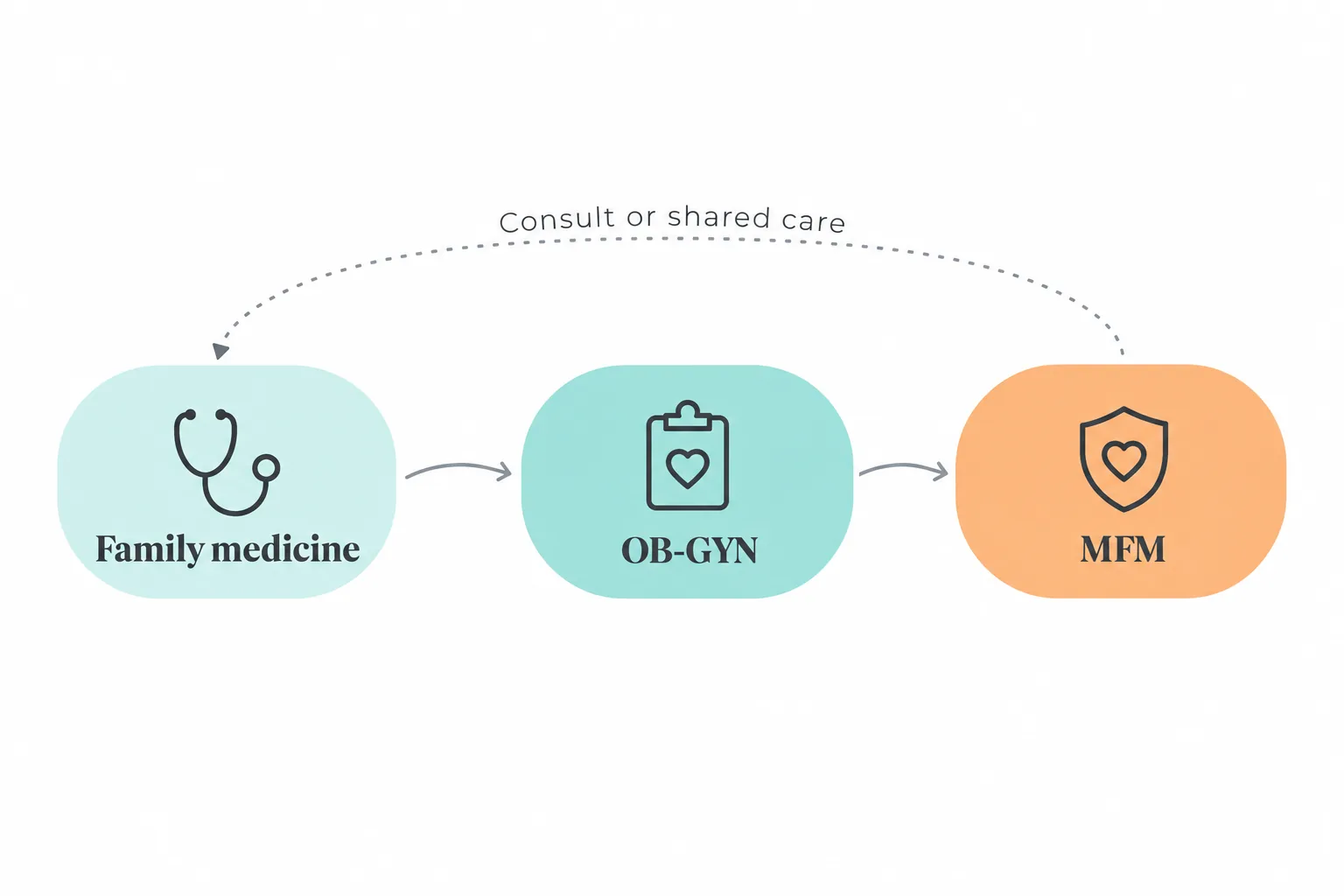
An OB-GYN may be the right starting point if you want a clinician focused on obstetrics and gynecology, need evaluation for a gynecologic condition, or prefer a practice with obstetric and surgical services. A maternal-fetal medicine specialist (MFM) is an OB-GYN with additional training in complex pregnancies.
A history such as a prior pregnancy complication, multiple pregnancy, significant chronic condition, or a new concern during pregnancy may lead your clinician to recommend an OB-GYN or MFM consultation or shared care. These factors do not create a one-size-fits-all rule. ACOG’s prenatal-care guidance notes that the type and frequency of care may change with a person’s health needs.
If your needs change during pregnancy
Pregnancy care plans can change as new health information becomes available. A family physician, OB-GYN, midwife, or MFM may coordinate care or recommend a transfer if a new need is outside the current practice’s scope. Ask how the practice shares records, who will coordinate referrals, and whether the clinicians work with the same hospital.
A transfer or shared-care arrangement may be possible, but timing, provider availability, insurance, and hospital arrangements vary. Ask early if you are considering a change.
Ask how labor and delivery are staffed
Before choosing a practice, find out:
- Where the provider has hospital privileges and where deliveries take place.
- Whether the person you see for prenatal visits may be on call for your birth.
- How call coverage works if your provider is unavailable.
- Who can perform a cesarean delivery and what happens if a higher level of care is needed.
- Whether postpartum and newborn visits are included or arranged with another clinician.
Insurance, referrals, and cost
Referral rules depend on the health plan. Federal rules give direct access to a participating obstetrics/gynecology professional under certain plans that require members to designate a primary care provider. The rule does not remove network requirements, coverage limits, or prior authorization requirements for particular services. Read the plan terms or call the insurer to confirm.
Before booking, ask whether the clinician and delivery hospital are in network, whether the plan requires a referral, what services require prior authorization, and what costs may be billed separately. Ask the practice and insurer about prenatal visits, lab work, ultrasounds, anesthesia, and the delivery facility.
Questions to ask before you choose
- Does this clinician provide prenatal care, attend births, or both?
- Which hospital do you use, and who is on call for labor and delivery?
- What services can this clinician provide, including cesarean delivery, and what is the backup plan?
- When do you consult or co-manage with an OB-GYN or MFM?
- Do you provide postpartum or newborn care, or should I arrange that with another clinician?
- Are the clinician and hospital in my insurance network, and do I need a referral?
Frequently asked questions
Related readingWhat Is a Concierge OB and Is It Worth It? Pregnancy GuideRead the guide →Frequently asked questions
Can a family medicine doctor deliver a baby?
Does every family medicine doctor provide prenatal care?
Do I need both a primary care doctor and an OB-GYN during pregnancy?
Do I need a referral to see an OB-GYN?
Can I switch from a family medicine doctor to an OB-GYN during pregnancy?
Pregnancy care at MWC
If you are comparing a family medicine doctor vs OB for pregnancy in Minnesota or western Wisconsin, MWC lists OB-GYN, midwife, and concierge OB options through its Family Medicine practice. Its midwives and OB physicians deliver in hospital settings. Learn about MWC’s prenatal care, labor and delivery, and postpartum care. MWC also explains its personalized care approach in Your Care, Your Way.
MWC lists locations in Maplewood, Woodbury, and Apple Valley, Minnesota, and Hudson, Wisconsin. Contact MWC to confirm current providers, availability, hospital arrangements, and insurance participation.