
Your first prenatal appointment usually includes a detailed health-history review, blood-pressure and weight checks, blood and urine tests, due-date estimation, and time to discuss symptoms, medications, prenatal vitamins, screening options, and next steps. A physical or pelvic exam and an early ultrasound may also be recommended, depending on your health, symptoms, and stage of pregnancy.

Your first prenatal appointment marks the beginning of an ongoing relationship with your pregnancy care team. It is often longer than later visits because your provider needs time to understand your health, confirm important pregnancy details, discuss early testing, and answer the questions that have come up since your positive test.
No two first visits are exactly alike. What happens depends on how far along you are, your symptoms, your medical and pregnancy history, and the way your clinic organizes early care. This guide explains what is commonly included, what may be recommended only in certain situations, how to prepare, and which questions can help you leave with a clear plan.
When Should You Schedule Your First Prenatal Appointment?
Call a pregnancy care provider after a positive home pregnancy test. Many practices schedule a first comprehensive prenatal appointment during the first trimester, often around 8 to 10 weeks from the first day of the last menstrual period. However, timing varies by practice and individual circumstances.
This timing is consistent with ACOG’s current prenatal-care guidance, which supports completing an initial prenatal assessment before 10 weeks from the last menstrual period or within a reasonable timeframe after pregnancy is identified.
Your care team may recommend earlier evaluation if you have pain or bleeding, uncertain dates, fertility treatment, a prior ectopic pregnancy, repeated pregnancy loss, or a medical condition that could affect pregnancy. Even when the full prenatal appointment is scheduled several weeks away, the office can advise you about medications, prenatal vitamins, symptoms, and any care you may need sooner.
If you are already 10 or 12 weeks pregnant and have not started care, do not let embarrassment delay you further. Call now. Your provider can review which tests or screening windows need attention and build a plan from where you are today.
What to Do After a Positive Pregnancy Test
You do not need to plan the entire pregnancy at once. Begin with a few practical steps:
- Contact a prenatal care provider and ask when you should be seen.
- Write down the first day of your last menstrual period, if you know it.
- Start or continue a prenatal vitamin. The CDC recommends 400 micrograms of folic acid daily for people who can become pregnant; some patients need a different amount, so ask your clinician what is appropriate for you.
- Make a complete list of prescriptions, over-the-counter medicines, vitamins, and herbal products. Do not stop a prescribed medication without guidance.
- Avoid alcohol, tobacco, and recreational drugs, and ask for help if stopping is difficult.
- Note any symptoms and questions you want to discuss.
For practical guidance on caffeine, alcohol, food safety, and common dietary concerns, exploring foods and drinks to avoid during pregnancy helps clarify what to limit or avoid throughout each stage.
Is Pregnancy Confirmation the Same as the First Prenatal Visit?
Not always. Some clinics schedule a short pregnancy-confirmation visit before the comprehensive prenatal appointment. Confirmation may involve a urine test, blood testing, an ultrasound, or a review of your dates and symptoms. The full first prenatal appointment usually goes further by reviewing your complete health history, ordering prenatal labs, discussing screening choices, and planning ongoing care.
Ask the office what your scheduled visit includes so you know whether to expect an ultrasound, laboratory work, a physical exam, or a separate follow-up appointment.
How Long Does the First Prenatal Appointment Take?
The first visit is commonly longer than a routine prenatal check because it includes history-taking, counseling, questions, and care planning. Appointment length varies by clinic and by whether testing, an examination, or ultrasound happens on the same day. When scheduling, ask how much time to allow and whether you should arrive early for paperwork or a urine sample.
What Happens at your First Prenatal Appointment?
The visit usually combines three goals: understanding your health, establishing a pregnancy-related baseline, and creating a plan for the months ahead.
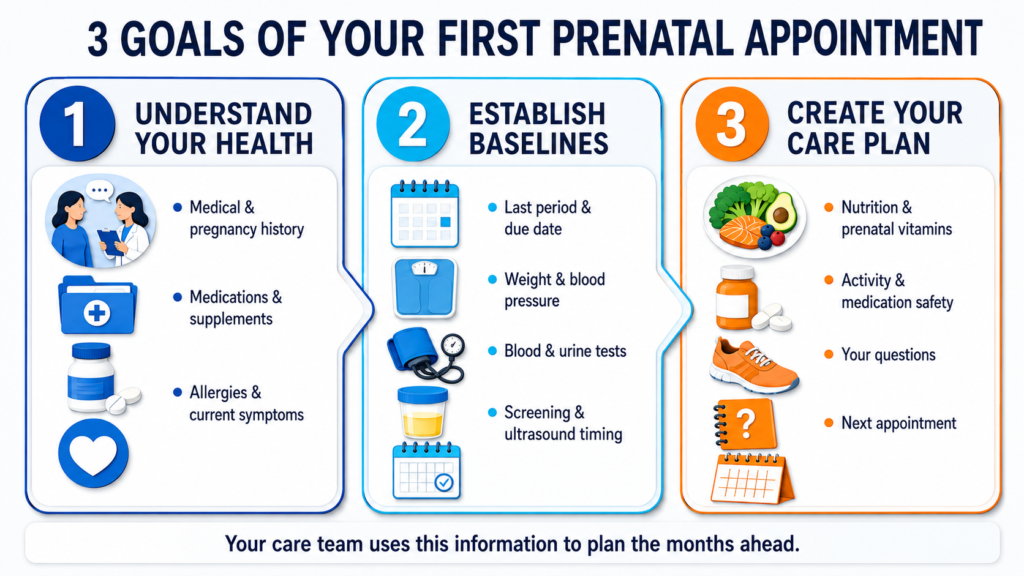
Common components include:
- A review of your last menstrual period and estimated due date.
- Your medical, surgical, mental-health, family, genetic, and pregnancy history.
- A review of medications, supplements, allergies, and current symptoms.
- Weight and blood-pressure measurements.
- Blood and urine testing.
- Discussion of nutrition, prenatal vitamins, activity, medication safety, and early-pregnancy symptoms.
- Information about genetic screening, carrier screening, and ultrasound timing.
- Time for your questions and scheduling the next visit.
What Is Usually Included vs. What Depends on Your Situation?
| Usually included or discussed | May be recommended depending on your situation |
| Health and pregnancy history | Pelvic or breast examination |
| Medication and supplement review | Pap test or infection testing if due or indicated |
| Blood pressure and weight | Serial hCG blood tests |
| Routine prenatal blood and urine tests | Early ultrasound |
| Due-date discussion | Additional genetic counseling or testing |
| Prenatal vitamin and lifestyle guidance | Earlier or more frequent monitoring |
| Questions and follow-up plan | Referral to a maternal-fetal medicine specialist |
This distinction matters because a test or ultrasound mentioned in another person’s pregnancy story may not be needed at your visit. Your provider should explain what is recommended for you and why.
Medical History, Vitals, and Physical Examination
Your provider will ask about chronic conditions, past surgeries, allergies, mental health, previous pregnancies, miscarriages, C-sections, fertility treatment, and complications such as high blood pressure or gestational diabetes. Family history and the health history of the baby’s biological father may also help guide genetic-screening discussions.
Some questions may feel personal, including questions about alcohol or substance use, safety at home, food access, or emotional health. These topics can affect pregnancy care, and honest answers help your team offer appropriate support. The conversation should be respectful and free of judgment.
Your weight and blood pressure are commonly recorded to establish a baseline. A general physical, breast exam, pelvic exam, or Pap test may be offered when clinically appropriate. If physical examinations cause discomfort or anxiety, tell your provider before the exam. You can ask what each step is for, request that the clinician explain before touching you, and discuss ways to make the examination more comfortable.
Blood Tests, Urine Tests, and Pregnancy Confirmation
Early pregnancy bloodwork helps your care team understand your baseline health and identify conditions that may need monitoring. Testing may include:
| Test | What it may evaluate |
| Blood type and Rh factor | Whether additional Rh-related care may be needed |
| Complete blood count | Anemia, platelet levels, and other blood findings |
| Infection screening | Selected infections that may affect pregnancy |
| Immunity testing | Protection against certain infections |
| Urine test and culture | Bacteria, infection, protein, glucose, or other findings |
| Genetic or carrier screening | Risk of selected chromosomal or inherited conditions |
Ask which tests are routine, which are optional, when the results should become available, and how the office will contact you.
You may also discuss carrier screening and non-invasive prenatal testing, commonly called NIPT. These are screening tests rather than definitive diagnoses. For better clarity on genetic testing during pregnancy and NIPT, including timing, possible results, and limitations, it helps to look at how each test works in practice.
If you are still planning a pregnancy or want to understand inherited-condition screening, see planning a pregnancy with carrier screening. Your provider should explain what each test can and cannot determine and what additional testing may be recommended after a higher-risk result.
Ultrasound and Due-Date Estimation
An ultrasound does not happen at every first prenatal appointment. It may be performed or scheduled when your dates are uncertain, you have pain or bleeding, you conceived through fertility treatment, your provider needs to confirm pregnancy location or viability, or it is part of the clinic’s routine.
An early scan may be abdominal or transvaginal. A transvaginal scan can provide a clearer view very early in pregnancy. Depending on gestational age, ultrasound may help confirm that the pregnancy is in the uterus, estimate gestational age, identify more than one embryo, and assess cardiac activity when developmentally appropriate.
What an Early Ultrasound May or May Not Show
Very early ultrasound findings can be inconclusive simply because the pregnancy is earlier than expected. Not seeing an embryo or cardiac activity on one early scan does not always establish that something is wrong.
ACOG’s guidance on early pregnancy loss emphasizes the importance of diagnostic certainty before treatment, because a single ultrasound or laboratory result may not be sufficient in every situation. Depending on the findings, repeating the ultrasound or reviewing serial blood-test results may be appropriate.
Your clinician may compare the findings with your dates, symptoms, and laboratory results, then recommend a repeat scan after an appropriate interval.
Your estimated due date is often calculated from the first day of your last menstrual period and may be confirmed or adjusted using ultrasound measurements. It is an estimate used for time screening and care, not a guaranteed delivery date.
What to Bring to Your First Prenatal Appointment
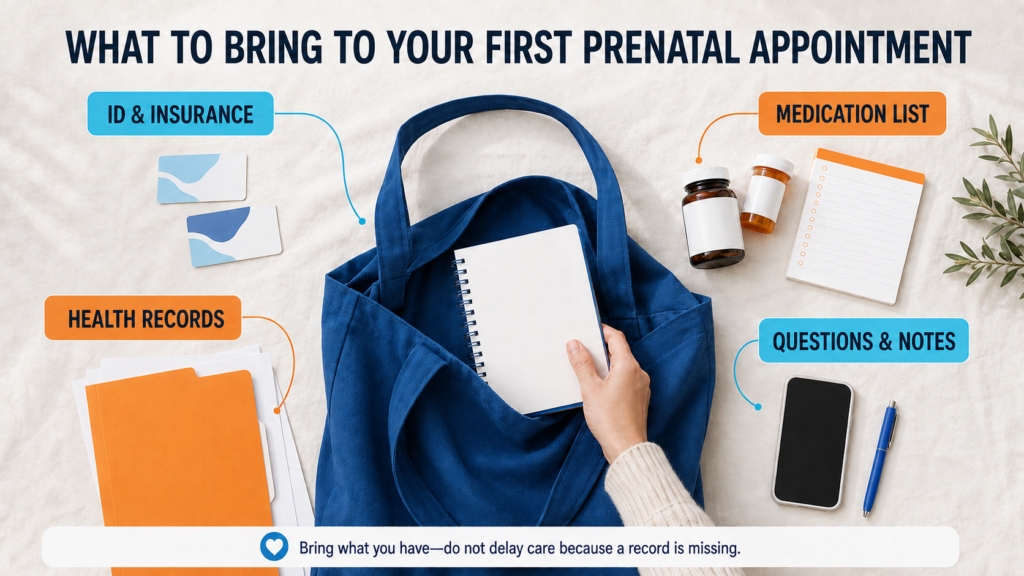
Bring what you can; do not postpone care because you cannot locate every record. A useful preparation checklist includes:
- Photo ID and insurance information.
- The first day of your last menstrual period and any cycle-tracking information.
- A list or photos of all prescriptions, over-the-counter medicines, vitamins, supplements, and herbal products.
- Allergy information.
- Records from prior pregnancies, surgeries, fertility treatment, recent laboratory testing, or relevant specialists.
- Family medical and genetic-history notes, if available.
- A list of current symptoms.
- Your written questions.
- Contact information for your pharmacy and other clinicians.
Ask whether your partner or support person may attend and whether the office needs you to arrive with a full bladder, fast, or follow any other instructions. Do not assume fasting is required; confirm with the clinic.
Questions to Ask at Your First Prenatal Visit
You do not have to ask every question below. Choose the ones that matter to your health, values, and daily life, and leave space to add questions that arise during the appointment.

Due Date and Pregnancy Confirmation
- How far along am I, and how was my due date calculated?
- Has the pregnancy been confirmed, or do I need additional testing?
- Will I have an ultrasound today or at another appointment?
- What can an ultrasound reasonably show at this stage?
Medical History and Risk Factors
- Does anything in my medical, surgical, family, or pregnancy history change my care plan?
- Do you consider this a high-risk pregnancy? If so, what additional monitoring may be needed?
- Should I continue seeing any of my current specialists?
- Are there mental-health resources available during pregnancy?
Medications, Supplements, and Prenatal Vitamins
- Are my prescriptions and over-the-counter medicines safe to continue?
- Which prenatal vitamin do you recommend, and do I need additional folic acid, iron, or other nutrients?
- What can I safely use for nausea, headache, allergies, constipation, or heartburn?
- Who should I contact before starting a new medicine or supplement?
Tests, NIPT, and Ultrasound
- Which blood and urine tests are routine, and what does each one check?
- Which screening tests are optional?
- Should I consider carrier screening, NIPT, or diagnostic testing?
- What are the benefits, limitations, timing, and possible next steps for each option?
- How and when will I receive results?
Symptoms, Food, Exercise, and Lifestyle
- Which symptoms are common, and which require a call?
- What foods, drinks, fish, or supplements should I limit or avoid?
- Is my current exercise routine appropriate?
- Is sex safe for me during this pregnancy?
- What guidance should I follow for caffeine, travel, dental care, vaccines, and work exposures?
If you are considering chiropractic treatment for pregnancy-related discomfort, you can also learn whether chiropractic care is safe during pregnancy and discuss your circumstances with your prenatal provider.
Provider Access and Future Appointments
- Who will I see during prenatal visits and at delivery?
- How often will appointments be scheduled?
- How do I reach the care team after hours?
- Where should I go for urgent concerns?
- Which hospital or birth center does the practice use?
Birth Planning and Postpartum Support
- When will we begin discussing birth preferences?
- What childbirth, breastfeeding, or newborn-care education is available?
- What support is available for mental health, lactation, pelvic-floor care, and postpartum recovery?
- How does the practice support patients if their preferences or pregnancy needs change?
Questions Partners or Support People May Want to Ask
A partner or support person can help remember information and understand how to offer practical support. Useful questions include:
- Which symptoms should we watch for at home?
- How can I support nutrition, rest, medication routines, and appointment preparation?
- May I attend future appointments and ultrasounds?
- Who should I call if the patient is too unwell to call?
- What changes in mood or behavior should prompt us to seek help?
- When should we begin discussing birth and postpartum support?
The pregnant patient remains the decision-maker. A support person’s role is to listen, learn, and help, not to speak over the patient.
Choosing an OB-GYN, Midwife, or Concierge Care Model
Your first visit is also an opportunity to understand how the practice provides care. An OB-GYN is a physician trained in pregnancy, birth, surgery, and reproductive health. A certified nurse-midwife provides pregnancy and birth care and may emphasize low-intervention, relationship-centered support for appropriate pregnancies. Collaborative practices may make it possible to benefit from both models.
Concierge pregnancy care may offer longer appointments, greater continuity, enhanced access, or additional support, depending on the program. Ask what each option includes, which clinicians attend deliveries, how complications are handled, and whether additional fees apply.
At MWC Pregnancy, patients can discuss available OB-GYN, midwife, and concierge options with the care team and choose an approach suited to their health needs and preferences.
What Happens After the First Appointment?
Before leaving, confirm what happens next. You may need laboratory testing, an ultrasound, a follow-up discussion about screening choices, or a routine prenatal appointment several weeks later. The schedule depends on your stage of pregnancy, health needs, test results, and the clinic’s model of care.
Write down:
- The date or timeframe of your next appointment
- Tests or referrals you need to schedule
- Medication or prenatal-vitamin changes
- Symptoms that should prompt a call
- The phone number or portal to use for questions
Results, Follow-Up, and the Next Visit
Ask how normal and abnormal results are communicated and how long results typically take. A portal notification without context can create unnecessary worry, so find out whether a clinician will contact you when interpretation or follow-up is needed.
Later visits are usually shorter and focus on your health, symptoms, the baby’s development, and upcoming screening or preparation. Visit frequency is individualized; your provider should explain the expected schedule and any reason you may need more frequent care.
Warning Signs That Require an Earlier Call
Contact your pregnancy care team promptly if you are concerned about a symptom. Seek urgent medical guidance for heavy bleeding, severe or one-sided abdominal or pelvic pain, shoulder pain, fainting or severe dizziness, difficulty breathing, chest pain, fever, or vomiting that prevents you from keeping down fluids. These symptoms do not always mean there is a serious problem, but you should not wait for a routine appointment.
If symptoms feel severe or life-threatening, call emergency services or go to the emergency department.
Frequently Asked Questions
Will I get an ultrasound at my first prenatal appointment?
Maybe. Ultrasound timing depends on gestational age, symptoms, history, and clinic routine. Ask when scheduling whether an ultrasound is planned and whether it will occur during a separate appointment.
Will I hear the heartbeat at the first visit?
It depends on how far along the pregnancy is and which method is used. Cardiac activity may be seen on ultrasound before it can be heard with a handheld Doppler. If it is too early, your provider may recommend waiting and checking again.
Can a Pap test be performed during pregnancy?
A Pap test may be performed during pregnancy when you are due, and your clinician recommends it. Ask why it is needed, what to expect, and whether light spotting afterward is possible.
Can I eat before the appointment?
Usually, but instructions vary if specific laboratory tests or procedures are planned. Ask the clinic rather than fasting unnecessarily.
Can my partner come with me?
Many practices welcome a partner or support person, although policies and room limitations vary. Confirm with the office in advance.
Is 10 or 12 weeks too late for a first prenatal visit?
Not necessarily, but schedule as soon as possible. Your provider can review your dates, health, symptoms, and any time-sensitive screening decisions without judgment.
Begin Prenatal Care With MWC Pregnancy
Your first prenatal appointment should give you more than a checklist of completed tests. It should help you understand your pregnancy, know whom to contact, and feel comfortable asking questions.
MWC Pregnancy, part of Minnesota Women’s Care, provides personalized Minnesota pregnancy care through OB-GYN, midwife, and concierge options. Contact the MWC Pregnancy team to confirm the right time and location for your first prenatal appointment and begin building a care plan around your needs.
Medical review note: This article should be reviewed by a qualified MWC Pregnancy clinician before publication, and the reviewer’s verified name and credentials should be displayed near the top of the page.
This article provides general educational information and does not replace individualized medical advice. Testing, examination, ultrasound, and appointment schedules vary. Contact a qualified healthcare professional about your circumstances or urgent symptoms.